
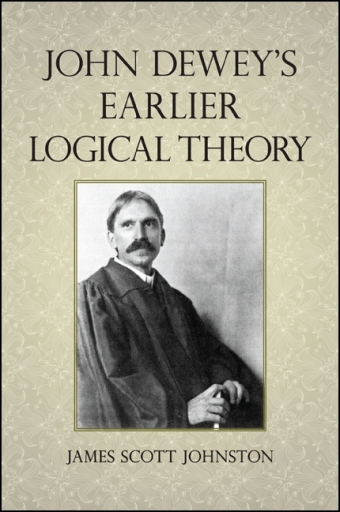
John Dewey's Earlier Logical Theory
Herausgegeben von State University of New York Press
English
274 Seiten
2014
PDF
Buy at Crisol Ebooks
🇵🇪
 Bajalibros Argentina
🇦🇷
Shop besuchen →
Bajalibros Argentina
🇦🇷
Shop besuchen →
 Bajalibros Latam
🇺🇸
Shop besuchen →
Bajalibros Latam
🇺🇸
Shop besuchen →
 Bookshop Uruguay
🇺🇾
Shop besuchen →
Bookshop Uruguay
🇺🇾
Shop besuchen →
 Catademic
🇺🇸
Shop besuchen →
Catademic
🇺🇸
Shop besuchen →
Verfügbar in 9 Buchhandlungen
Bajalibros Argentina
🇦🇷
Shop besuchen →
Bajalibros Latam
🇺🇸
Shop besuchen →
Bookshop Uruguay
🇺🇾
Shop besuchen →
Catademic
🇺🇸
Shop besuchen →





Über dieses Buch
<p><b>Analysis of Dewey's pre-1916 work on logic and its relationship to his better-known 1938 book on the topic.</b></p><p>When John Dewey's logical theory is discussed, the focus is invariably on his 1938 book <i>Logic: The Theory of Inquiry</i>. His earlier logical works are seldom referenced except in relation to that later work. As a result, Dewey's earlier logical theory is cut off from his later work, and this later work receives a curiously ahistorical gloss. Examining the earlier works from <i>Studies in Logical Theory</i> to <i>Essays in Experimental Logic</i>, James Scott Johnston provides an unparalleled account of the development of Dewey's thinking in logic, examining various themes and issues Dewey felt relevant to a systematic logical theory. These include the context in which logical theory operates, the ingredients of logical inquiry, the distinctiveness of an instrumentalist logical theory, and the benefit of logical theory to practical concerns-particularly ethics and education. Along the way, and complicating the standard picture of Dewey's logic being indebted to Charles S. Peirce, William James, and Charles Darwin, Johnston argues that Hegel is ultimately a more important influence.</p>
Kategorien
- Sprache
- English
Teilen
Das könnte dir auch gefallen

Giannini público
Humberto Giannini, Vicerrectoría De Extensión Y Comunicaciones Y Facultad De Filosofía Y Humanidades De La Universidad De Chile
Foucault & a Educação
Veiga-Neto, Alfredo

Com a maturidade fica-se mais jovem
Hesse, Hermann
G. W. F. Hegel
Baur, Michael
El filósofo interior
Ikeda, Daisaku, Marinoff, Lou
Historia alternativa de la felicidad
González Iglesias, Juan Antonio