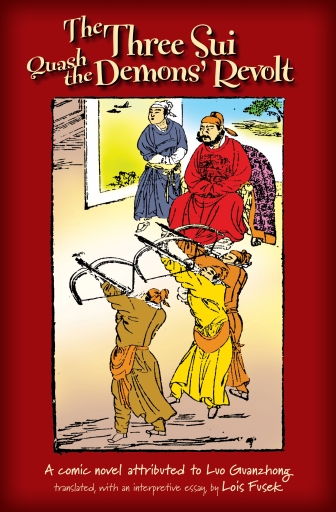
The Three Sui Quash the Demons' Revolt
Herausgegeben von University of Hawaii Press
English
321 Seiten
2010
ISBN 9780824860707
Geschätzte Lesezeit: 5 Std. 53 Min.
PDF
Buy at Bajalibros Latam
🇺🇸
 Association of University Presses - Tienda FILUNI
🇺🇸
Shop besuchen →
Association of University Presses - Tienda FILUNI
🇺🇸
Shop besuchen →
 Bajalibros Argentina
🇦🇷
Shop besuchen →
Bajalibros Argentina
🇦🇷
Shop besuchen →
 Bookshop Uruguay
🇺🇾
Shop besuchen →
Bookshop Uruguay
🇺🇾
Shop besuchen →
 Catademic
🇺🇸
Shop besuchen →
Catademic
🇺🇸
Shop besuchen →
Verfügbar in 13 Buchhandlungen
Association of University Presses - Tienda FILUNI
🇺🇸
Shop besuchen →
Bajalibros Argentina
🇦🇷
Shop besuchen →
 Bookshop Uruguay
🇺🇾
Shop besuchen →
Catademic
🇺🇸
Shop besuchen →
Bookshop Uruguay
🇺🇾
Shop besuchen →
Catademic
🇺🇸
Shop besuchen →








Über dieses Buch
The twenty-chapter novel The Three Sui Quash the Demons’ Revolt is traditionally attributed to Luo Guanzhong (d. after 1364?), the alleged author of two of China’s most famous and beloved works of fiction, The Romance of the Three Kingdoms and The Water Margin. The Three Sui tells the story of the uprising of adherents of the Maitreya Buddha led by Wang Ze in 1047–1048. Wang Ze was eventually executed and all future heterodox activity outlawed.
Paradoxically, The Three Sui treats the rebellion as an occasion for slapstick, baggy-pants humor in which facts are distorted and wildly mixed with fiction. Wang Ze's real-life lieutenants show up as a comical peddler and a mysterious Daoist priest. A celebrated warrior takes part in the rebellion despite having died seventeen years earlier. Although the novel is divided into chapters and otherwise follows the traditional format for such extended narratives, a careful examination reveals The Three Sui is an arrangement of self-contained vernacular stories. No story bears an intrinsic relationship to any other story. And because the integrity of the various stories has been so remarkably preserved, The Three Sui is a vernacular novel in which the vernacular story reigns supreme.
Although the Wang Ze rebellion took place during the Northern Song dynasty (960–1127), ultimately The Three Sui is the story of the Ming dynasty (1368–1644) in Song masquerade. It calls attention to the social unrest, even anarchy, caused by the rising power and influence of movements like The White Lotus Society and warns of the Ming’s downfall unless such groups are contained. In this, the novel proved to be a prescient voice: The Ming collapsed as the result of a central authority weakened by mass sectarian uprisings.
The Three Sui has been little known and sadly overlooked by scholars of Chinese literature and history. Now this vibrant translation and insightful interpretive essay make this early example of Chinese vernacular fiction available to a broad audience interested in comparative literature and fiction.
Verfügbarkeit
The Three Sui Quash the Demons' Revolt ist als PDF in 13 Online-Buchhandlungen erhältlich. Zu den Buchhandlungen, die es führen, gehören Association of University Presses - Tienda FILUNI, Bajalibros Argentina, Bajalibros Latam.
- Sprache
- English
Teilen
Häufige Fragen
- In welchen Formaten ist The Three Sui Quash the Demons' Revolt erhältlich?
- The Three Sui Quash the Demons' Revolt ist als PDF in 13 Online-Buchhandlungen erhältlich.
- Wo kann ich The Three Sui Quash the Demons' Revolt kaufen?
- Du kannst The Three Sui Quash the Demons' Revolt bei Association of University Presses - Tienda FILUNI, Bajalibros Argentina, Bajalibros Latam kaufen. Vergleiche alle Optionen in der Liste auf dieser Seite.
- Wie lange dauert es, The Three Sui Quash the Demons' Revolt zu lesen?
- Bei durchschnittlichem Lesetempo dauert The Three Sui Quash the Demons' Revolt etwa 5 Std. 53 Min. (321 Seiten).
Bewertungen und Rezensionen
Noch keine Bewertungen. Sei der Erste, der dieses Buch rezensiert.
Anmelden um dieses Buch zu bewerten und zu rezensieren.