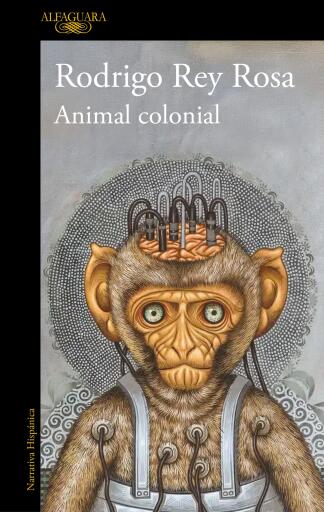
Rodrigo Rey Rosa’s ‘Animal Colonial’: The Dystopia That Doesn’t Need to Imagine the Future
I have a theory: the books we most need are the ones we most delay opening. Animal Colonial, the new novel by Rodrigo Rey Rosa, sat staring at me from my desk for three days before I could bring myself to start it.
It’s not that Rey Rosa frightens. It’s that books you already know, before reading them, are going to be right about everything — those are the ones that take courage.
The Guatemalan writer — winner of the Iberoamerican Prize for Literature José Donoso and Guatemala’s National Literature Prize — has spent his entire career building fictions that read like field reports. His novels have always carried that edge of reality barely concealed beneath layers of invention. But with Animal Colonial, Rey Rosa goes further: he takes us into a dystopian mega-prison where dreams of freedom don’t die suddenly. They die slowly, like a trapped animal that stops struggling.
The novel arrives at a moment when reality has long since surpassed any dark imagination. Mega-prisons are fashionable across Latin America. Penal systems don’t rehabilitate; they classify, contain, monetize. Rey Rosa needs to invent nothing: it’s enough to observe, transpose, give literary name to what already exists.
His prose is what it has always been: austere, surgical, without mercy. He learned the craft alongside Paul Bowles in Tangier, and that lesson in silence and economy shows in every line. In Animal Colonial, that restraint becomes a narrative device in itself: the narrator’s coldness is part of the horror. There is no rhetorical compassion. There is only precision.
I think of García Márquez writing about Colombian violence with that mixture of beauty and cruelty that defined a whole way of narrating the continent. Rey Rosa inherits that tension but carries it toward more austere territory. No hyperbole here. Hyperbole already is reality itself.
Animal Colonial is the kind of novel that makes you want to talk to someone when you finish it. Not to resolve anything — the novel resolves nothing, and that is its virtue — but to confirm that what you just read was as disturbing as it seemed. If you care about contemporary Latin American fiction, if a book that refuses to console you has ever moved you: find this novel.