
Artemis 2 and the Science of Going Back to the Moon

The last human being to see the Moon up close was Eugene Cernan, who climbed back into his lunar module in December 1972 and, with what now looks like spectacular overconfidence, promised he would not be the last. It took fifty-four years, but yesterday four astronauts aboard the Orion capsule finally proved him right — or at least began to.
Artemis 2, launched from Pad 39B at Kennedy Space Center on April 1st, carries Commander Reid Wiseman, Pilot Victor Glover, and Mission Specialists Christina Koch and Jeremy Hansen on a ten-day free-return trajectory around the Moon. The mission will swing approximately 4,100 miles beyond the lunar far side — a region no human has seen with their own eyes since the Apollo programme. The crew will not land. They will loop around and come home. And yet the engineering required to accomplish even this apparently modest feat is staggering.
Consider the heat shield. When Orion re-enters Earth's atmosphere, its base will endure temperatures approaching 5,000 degrees Fahrenheit — roughly half the surface temperature of the Sun. The ablative material chars and flakes away by design, each fragment carrying heat with it like a departing guest taking the bill. Getting this wrong is not an option. As Charles T. Baier documents in The Weakest Link, the Challenger disaster of 1986 came down to a rubber O-ring that could not handle cold weather. Spaceflight has always been a discipline where the smallest component can be the most lethal.
The computing power aboard Orion would have been inconceivable to the Apollo engineers. The Apollo guidance computer operated on roughly 74 kilobytes of memory — less than a modern thermostat. Orion's systems handle navigation, life support, and communications with a sophistication that makes the Moon landings look like they were managed on an abacus. Which, in a sense, they were. The fact that twelve people walked on the Moon with pocket-calculator technology remains one of the great feats of human stubbornness.
But the technical achievements of Artemis 2 are inseparable from its politics. Victor Glover is the first person of colour to travel to the Moon's vicinity. Christina Koch is the first woman. Jeremy Hansen, a Canadian Space Agency astronaut, is the first non-American to leave low Earth orbit. These milestones are real and significant, though one might reasonably ask why it took until 2026 to achieve any of them. The original space programme was built on the labour of figures whose stories were suppressed for decades — and, as Clara Jensen's unflinching Operation Paperclip: Nazis Who Joined NASA makes plain, on the expertise of men whose wartime records should have disqualified them from polite society, let alone government employment.
Artemis 2 is the middle chapter of a larger ambition. NASA's broader programme envisions a permanent outpost near the lunar south pole, the Gateway space station in lunar orbit, and — if funding and political attention survive multiple election cycles — crewed missions to Mars. The Moon, in this reading, is not the destination but the rehearsal. We go back in order to go further. Whether we actually will is another question. The history of space exploration is littered with abandoned plans, defunded programmes, and rockets that existed only as PowerPoint slides.
What the Moon can teach us, though, extends well beyond engineering. Josephine M. Gadson's Extinction Layer: The Cosmic Dust That Rewrote History traces how extraterrestrial material has shaped life on Earth in ways we are only beginning to understand. The lunar surface, unprotected by atmosphere or magnetic field, is a four-billion-year record of cosmic bombardment. Studying it is like reading a diary the Earth was too restless to keep.
So here we are, back in the neighbourhood after half a century away. Four people in a capsule, circling a rock that has captivated every civilisation that ever looked upward. The science is formidable. The symbolism is heavy. The question, as always with human spaceflight, is whether the species that built the rocket has the patience to follow through — or whether, fifty years from now, someone will be writing another article about going back.
Recommended reads
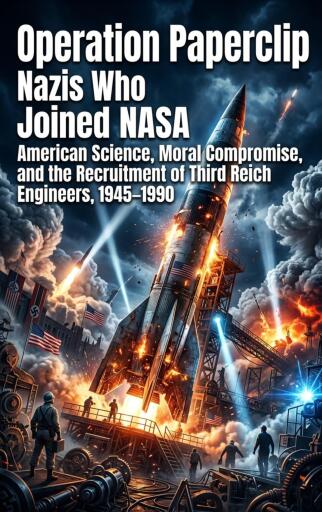
At the end of World War II, as Allied forces uncovered the full horror of Nazi atrocities, the United States governme...

On January 28, 1986, the Space Shuttle Challenger exploded 73 seconds after liftoff...
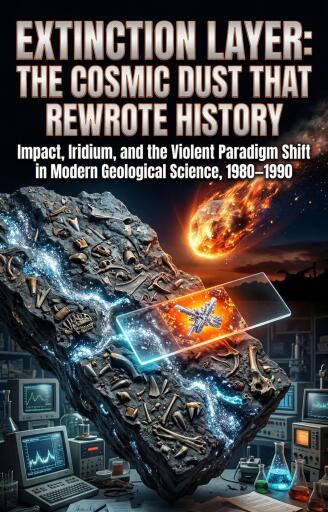
In the late 1970s, a geologist investigating a thin band of clay in Italy noticed something impossible...