César Aira Wrote a Novel in French in 1996, Never Published It, and a Contract Clause Just Brought It Back
Imagine you have a manuscript in French that you wrote in 1996, never published it, and thirty years later a publishing contract clause forces you to deliver an unpublished novel. What do you do? If you are César Aira, you dig it out, reread it, translate it into Spanish yourself—with a few improvements along the way—and publish it. That is the origin story of La sala: una novela francesa, the strangest and most honest book of the season, and possibly one of the most revealing documents about how the mind of one of literature's most productive and bewildering writers actually operates.
The backstory matters. In the 1990s, the slim novels published by Éditions Minuit were a cultural phenomenon in France—that imprint that published Beckett, Marguerite Duras, Claude Simon. Aira, who has always operated from the margins and the strange, thought he could write one. He found it decades later in a drawer. Now we read it in Spanish, translated by the same author who wrote it in French and who, in the process of translation, also improved it a little. Is that cheating, or is it exactly what all writers do but without admitting it?
The novel itself is pure Aira machine: an unemployed electrician moves from the Parisian suburbs to a small room in the city center and discovers a cinema showing continuous images of cemeteries and tombs. Young Koreans are constantly coming and going. Nobody explains anything. Aira never explains anything. That is the terms of the contract.
And then there is Duras. The War by Marguerite Duras is one of the most harrowing books written about waiting and loss; Duras as spectral presence in La sala is not a decorative homage but something stranger: the summoning of a ghost who was already a ghost while alive, someone who wrote from the edge of the sayable. The minimalism of Minuit as aesthetic stance, revisited from the distance and irony of an Argentine writer who never lived in Paris.
What does one do with a book written in another language, abandoned for decades, and recovered by a contractual clause? One reads it, above all. Because La sala is the kind of rarity that only an author like Aira can produce—someone who has published more than a hundred novels, who writes longhand in Buenos Aires cafés, and who has a working method as well-known as it is inexplicable: he does not rewrite, he does not revise, he moves forward. What is there, is there. What is missing, stays missing.
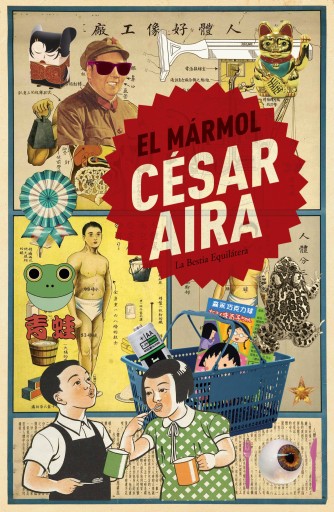
If you have not read any Aira yet, this might be the beginning—or the wrong book to start with and the right one for when you already know him. You might also try El mármol as another door into his peculiar universe. With Aira you never know which entrance is correct. That, too, is part of the deal.