
Rocky and Grace: The Friendship That Saved Two Worlds

There is a scene in Project Hail Mary that made me close the book. Not out of boredom — the exact opposite. Ryland Grace has just discovered he is not alone in the Tau Ceti system. There is another ship. Another species. Another being who also crossed the darkness between stars looking for an answer. And when Rocky emits his first series of musical chords, when those sounds fill the void between two life forms that should not be able to communicate, I felt something few novels have given me: the absolute certainty that I was witnessing the birth of a friendship.
Andy Weir has a reputation as a hard science fiction writer, the kind who fills pages with equations and engineering problems. And it's true. But Project Hail Mary is something else, something larger. It is a novel about the most radical loneliness a living being can experience — being completely alone, light-years from any other member of your species — and about how that loneliness breaks open in the most unexpected way.
Grace wakes up without memories on a ship in the middle of nowhere. His two crewmates are dead. Earth is dying. And he, a science teacher who never wanted to be an astronaut, has to solve a problem that the planet's best minds couldn't. Weir builds Grace's desperation with a precision that hurts. He isn't a tragic hero in the classical sense. He is an ordinary man, scared, who makes bad jokes to keep from collapsing. He reminded me of those García Márquez characters who face the impossible with a blend of stubbornness and tenderness, as if refusing to give up were the most honest form of dignity.
And then Rocky appears. A spider-shaped being with five arms, made of materials that function at extreme temperatures, who "sees" the world through sound and lives in an ammonia environment that would kill Grace in an instant. The reader's first reaction might be distance — this is not a friendly alien with human features, this is not E.T. But Weir does something extraordinary: he builds the friendship between Grace and Rocky note by note, like a musical composition. First the knocks on the hull. Then the repeated tones. Then the first shared words, clumsy, imprecise, full of misunderstandings that resolve themselves through infinite patience.
What moves me about this relationship is that there are no shortcuts. No telepathy, no universal translator, no magic moment where everything clicks. There is work. There are days of pointing at objects and repeating sounds. There is frustration and there are small victories. When Rocky says for the first time something Grace fully understands — "Friend!" — the word isn't a cheap narrative device. It is the result of pages and pages of mutual effort. And that makes it weigh like few words weigh in contemporary fiction.
The emotional structure of the novel made me think of Clarice Lispector, odd as it may sound to link her to science fiction. Lispector wrote about the fundamental strangeness of existing alongside another living being, about how real closeness — not comfortable closeness, but true closeness — demands giving up the idea that we can fully understand the other. Grace and Rocky never fully understand each other. Rocky cannot grasp the concept of music as aesthetic pleasure. Grace cannot imagine a world without light. But they help each other. They protect each other. They make each other laugh, even if laughter sounds different in each language.
The final sacrifice — I won't reveal it for those who haven't read it — is the ultimate proof that Weir understands something many sci-fi writers miss: that a story's greatness lies not in the scale of the problem, but in the honesty of the bond between those who face it. Grace doesn't save Earth through heroism. He saves it because he found someone worth doing it for, someone who also found in him a reason not to give up.
I read somewhere that Martha Wells' Murderbot Diaries series shares with this novel the ability to make relationships between non-human beings feel deeply human. That's true. There is something in recent speculative fiction that is exploring empathy beyond the boundaries of species, as if literature needed to leave Earth to remind us what it means to stand beside someone.
If you haven't read Project Hail Mary, I ask you to do so. Not for the science, though it's brilliant. Not for the mystery, though it grips. Read it for Rocky. Read it for that word — "Friend" — that sounds different when spoken by someone who crossed the stars to be at your side.
Recommended reads
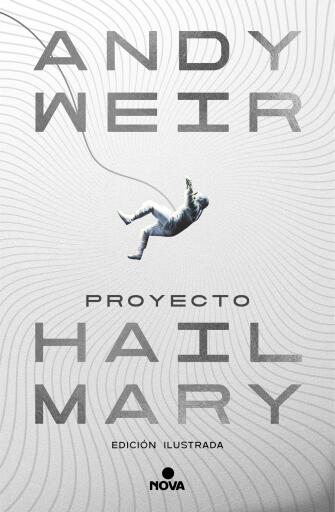
La edición ilustrada de la obra maestra de Weir sobre un astronauta solitario y su misión para salvar la Tierra.
El desenlace de la saga que redefinió el contacto con lo desconocido en la ficción.
Un robot asesino con ansiedad social: la serie que redefine la relación humano-máquina.
Where human ambition meets the impossible, beneath the surface of our deepest ocean.