
What Project Hail Mary Gets Right About Astrobiology

I remember a particular winter in Copenhagen, years ago, when a friend who studied astrophysics at the Niels Bohr Institute told me something that stayed lodged in my mind: "The universe is not hostile. It is indifferent." I thought of that sentence again while reading Andy Weir's Project Hail Mary, a novel that takes that cosmic indifference and turns it into the most urgent problem-solving exercise in literary science fiction.
The premise is deceptively simple. A microorganism called Astrophage — a single-celled creature that feeds on stellar energy — is dimming our sun. Earth has perhaps thirty years before the Petrova line, the threshold beyond which global temperatures drop enough to trigger an extinction-level ice age. Ryland Grace, a middle-school science teacher turned reluctant astronaut, wakes up alone on a ship bound for Tau Ceti, the one star in our neighborhood that seems immune to the infection. He cannot remember why he is there. He cannot remember his own name.
What makes this novel remarkable from a scientific standpoint is not merely that Weir did his homework — though he did, meticulously. It is that the science itself becomes the emotional engine of the story. Astrophage is not a plot device dressed in jargon. Weir constructs an organism with internal thermodynamic logic: it absorbs electromagnetic radiation across a specific spectral range, stores that energy with impossible efficiency, and propels itself through space using directed infrared emission. The biology is speculative, yes, but it respects the constraints of real chemistry. The organism's reliance on a magnetic field for navigation mirrors how certain bacteria on Earth orient themselves using magnetosomes.
The Petrova line — named after the Russian scientist who first identifies the threat — is another elegant piece of world-building grounded in actual climate science. Solar luminosity models, albedo feedback loops, ocean heat absorption: Weir threads real mechanisms through a fictional scenario with a care that recalls Arthur C. Clarke's dictum that any sufficiently advanced fiction should be indistinguishable from a peer-reviewed paper. Well, Clarke never quite said that. But he would have approved.
There is a deeper question here, one that transcends the engineering puzzles. When Grace encounters Rocky, an Eridian — an alien from 40 Eridani whose biology runs on ammonia instead of water — the novel becomes a kind of laboratory for thinking about what "life" actually means. Weir does not settle for rubber-forehead aliens. Rocky perceives the world through sound, not sight. His body operates at temperatures that would kill a human in seconds. His blood is not blood. And yet, the two of them sit together in a shared space, improvising a pidgin language from musical tones and scratched symbols, and something unmistakably like friendship emerges. This is astrobiology's deepest promise made tangible: that the universe's indifference does not preclude connection.
The interstellar travel in the novel also deserves attention. The Hail Mary uses Astrophage itself as fuel — a closed loop of elegant narrative logic. The ship accelerates at relativistic speeds, and Weir handles time dilation not as a dramatic flourish but as a structural constraint. There are no warp drives, no hyperspace. Just momentum, fuel budgets, and the relentless arithmetic of distance divided by velocity. For readers who grew up on Clarke's Odyssey or the meticulous orbital mechanics of hard science fiction, this feels like coming home.
I have read critiques that find Weir's prose functional, his characters thin. These are not entirely wrong. Weir writes like an engineer, not a poet. But there is a different kind of beauty here — the beauty of a problem correctly stated, of variables isolated and tested, of a hypothesis that holds under pressure. When Grace figures out how Astrophage reproduces, when he maps its life cycle across a star system, the pleasure is intellectual and genuine, closer to the satisfaction of reading a well-designed experiment than a well-turned metaphor.
In the end, what Project Hail Mary gets right is something most science fiction merely gestures toward: the idea that science is not a body of knowledge but a way of being in the world. A way of paying attention. Grace survives not because he is brave or strong, but because he looks carefully, tests patiently, and changes his mind when the data tells him to. In a time when certainty is marketed like a commodity, there is something quietly radical about a novel whose hero keeps saying, "I need to run more tests."
What would it mean, I wonder, if more of us approached the unknown that way?
Recommended reads
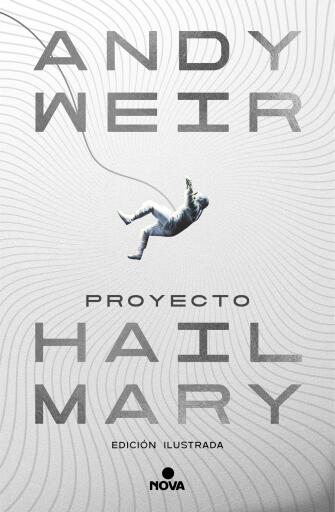
The illustrated edition of Weir's masterwork about a lone astronaut's mission to save Earth from an extinction-level...
Newton's revolutionary ideas about the laws governing the universe.
The stunning conclusion to Clarke's legendary Space Odyssey saga.
When a space rock survives atmospheric entry, it becomes more than a scientific curiosity.