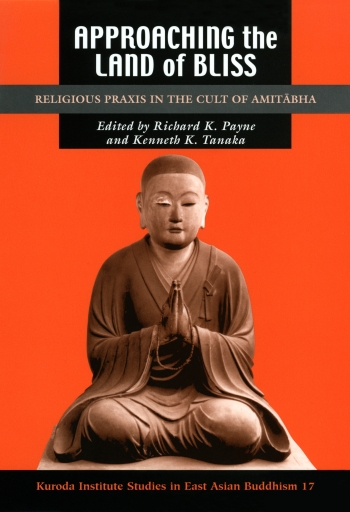
Approaching the Land of Bliss
Published by University of Hawaii Press
English
320 pages
2003
ISBN 9780824842987
Estimated reading time: 5 h 52 min
PDF
Buy at Association of University Presses - Tienda FILUNI
🇺🇸
 Bajalibros Argentina
🇦🇷
Visit store →
Bajalibros Argentina
🇦🇷
Visit store →
 Bajalibros Latam
🇺🇸
Visit store →
Bajalibros Latam
🇺🇸
Visit store →
 Bookshop Uruguay
🇺🇾
Visit store →
Bookshop Uruguay
🇺🇾
Visit store →
 Catademic
🇺🇸
Visit store →
Catademic
🇺🇸
Visit store →
Available at 13 bookshops
 Bajalibros Argentina
🇦🇷
Visit store →
Bajalibros Latam
🇺🇸
Visit store →
Bookshop Uruguay
🇺🇾
Visit store →
Catademic
🇺🇸
Visit store →
Bajalibros Argentina
🇦🇷
Visit store →
Bajalibros Latam
🇺🇸
Visit store →
Bookshop Uruguay
🇺🇾
Visit store →
Catademic
🇺🇸
Visit store →








About this book
The discourse of Buddhist studies has traditionally been structured around texts and nations (the transmission of Buddhism from India to China to Japan). And yet, it is doubtful that these categories reflect in any significant way the organizing themes familiar to most Buddhists. It could be argued that cultic practices associated with particular buddhas and bodhisattvas are more representative of the way Buddhists conceive of their relation to tradition. This volume aims to explore this aspect of Buddhism by focusing on one of its most important cults, that of the Buddha Amitâbha. Approaching the Land of Bliss is a rich collection of studies of texts and ritual practices devoted to Amitâbha, ranging from Tibet to Japan and from early medieval times to the present.
The cult of Amitâbha is identified as an integral part of Tibet’s Mahayana Buddhist tradition in the opening essay by Matthew Kapstein. Next Daniel Getz, Jr., locates the Pure Land patriarch Shengchang more firmly in a Huayancontext and his Pure Conduct Society not so much in the propagation of Pure Land praxis but as a means of modifying anti-Buddhist sentiments. Jacqueline Stone’s study of the practice of reciting nenbutsu at the time of death gives us an understanding of both the practice itself and the motivating logic behind it. Kakuban—the founder of the one major "schism" in the history of the Shingon tradition—is placed in a typology of Japanese Pure Land thought inJames Sanford’s study of Kakuban’s Amida hishaku. Hank Glassman contributes an essay on the "subsidiary cult" of Chujohime, whichderived from the cult of Amitâbha but grew to such importance that it displaced the latter as the focus of worship in medieval Japan. In his examination of "radical Amidism," Fabio Rambelli discusses different forms of Japanese Pure Land thought that constitute divergences from the mainstream or normative forms. Richard Jaffeexamines the work of the seventeenth-century cleric Ungo Kiyo, who sought to match his teaching to the needs and capacities of hisdisciples. Todd Lewis highlights the importance of cultic life and finds traces of the desire for rebirth into Sukhavati in stupa worship among Newari Buddhists. Charles Jones’ "thick description" of a one-day recitation retreat in Taiwan provides us with a closer look at how the cult of Amitâbha continues in present-day East Asia.
Approaching the Land of Bliss moves beyond the limitations of defining Buddhism in terms of its textual corpus or nation states,opening up the cult of Amitâbha in Nepal, Tibet, China, and Taiwan, and uncovering new aspects of Japanese Pure Land.
Contributors: Daniel A. Getz, Jr.; Hank Glassman; Richard Jaffe; Charles B. Jones; Matthew T. Kapstein; Todd T. Lewis; Richard K. Payne; Fabio Rambelli; James H. Sanford; Jacqueline I. Stone.
Availability
Approaching the Land of Bliss is available as PDF at 13 online bookshops. Bookshops carrying it include Association of University Presses - Tienda FILUNI, Bajalibros Argentina, Bajalibros Latam.
Genres
- Language
- English
Share
Frequently asked questions
- In what formats is Approaching the Land of Bliss available?
- Approaching the Land of Bliss is available as PDF at 13 online bookshops.
- Where can I buy Approaching the Land of Bliss?
- You can buy Approaching the Land of Bliss at Association of University Presses - Tienda FILUNI, Bajalibros Argentina, Bajalibros Latam. Compare every option in the list on this page.
- How long does it take to read Approaching the Land of Bliss?
- At an average reading pace, Approaching the Land of Bliss takes about 5 h 52 min to read (320 pages).
Ratings & reviews
No ratings yet. Be the first to review this book.
Sign in to rate and review this book.