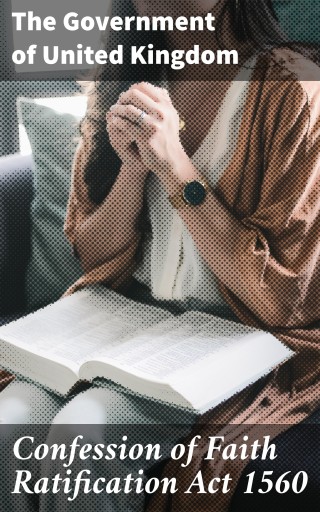
Confession of Faith Ratification Act 1560
By The Government of United Kingdom
Published by Good Press
English
2020
ISBN 4064066441661
eBook
Buy at Sanborns Ebooks
🇲🇽
 Alpha Books
🇨🇴
Visit store →
Alpha Books
🇨🇴
Visit store →
 Bajalibros Argentina
🇦🇷
Visit store →
Bajalibros Argentina
🇦🇷
Visit store →
 Bajalibros Latam
🇺🇸
Visit store →
Bajalibros Latam
🇺🇸
Visit store →
 Bookshop Uruguay
🇺🇾
Visit store →
Bookshop Uruguay
🇺🇾
Visit store →
 Crisol Ebooks
🇵🇪
Visit store →
Crisol Ebooks
🇵🇪
Visit store →
Available at 15 bookshops
Alpha Books
🇨🇴
Visit store →
Bajalibros Argentina
🇦🇷
Visit store →
Bajalibros Latam
🇺🇸
Visit store →
Bookshop Uruguay
🇺🇾
Visit store →
Crisol Ebooks
🇵🇪
Visit store →










About this book
The 'Confession of Faith Ratification Act 1560' serves as a pivotal document in the evolution of religious doctrine and state power in England during the Reformation. Written in a formal, legalistic style characteristic of 16th-century parliamentary language, this act ratified the Scots Confession, articulating the theological underpinnings that shaped Protestant beliefs in the United Kingdom. It reflects the broader conflict between Catholicism and burgeoning Protestant ideologies, marking a crucial juncture in the establishment of the Church of England and the relationship between governance and faith. The Government of the United Kingdom, as the acting authority behind this document, sought to navigate the tumultuous waters of religious dissent and political legitimacy. The act is a response to the factionalism of post-Reformation society, deeply influenced by the works of reformers such as John Calvin and John Knox. The need for coherence in belief led to the issuance of this act, indicating a shift towards the embrace of a unified Protestant identity. This book is essential for scholars and enthusiasts of religious history, legal studies, and British political evolution. It offers profound insights into the ideological battles of the era, serving as both a historical artifact and a narrative tool for understanding the complexities of faith and governance in early modern England. Engage with this seminal work to explore the intricate interplay of theology and statecraft.
In this enriched edition, we have carefully created added value for your reading experience:
- A succinct Introduction situates the work's timeless appeal and themes.
- The Synopsis outlines the central plot, highlighting key developments without spoiling critical twists.
- A detailed Historical Context immerses you in the era's events and influences that shaped the writing.
- An Author Biography reveals milestones in the author's life, illuminating the personal insights behind the text.
- A thorough Analysis dissects symbols, motifs, and character arcs to unearth underlying meanings.
- Reflection questions prompt you to engage personally with the work's messages, connecting them to modern life.
- Hand‐picked Memorable Quotes shine a spotlight on moments of literary brilliance.
- Interactive footnotes clarify unusual references, historical allusions, and archaic phrases for an effortless, more informed read.
Availability
Confession of Faith Ratification Act 1560 is available as eBook at 15 online bookshops. Bookshops carrying it include Alpha Books, Bajalibros Argentina, Bajalibros Latam.
Genres
- Language
- English
Share
Frequently asked questions
- In what formats is Confession of Faith Ratification Act 1560 available?
- Confession of Faith Ratification Act 1560 is available as eBook at 15 online bookshops.
- Where can I buy Confession of Faith Ratification Act 1560?
- You can buy Confession of Faith Ratification Act 1560 at Alpha Books, Bajalibros Argentina, Bajalibros Latam. Compare every option in the list on this page.
Ratings & reviews
No ratings yet. Be the first to review this book.
Sign in to rate and review this book.