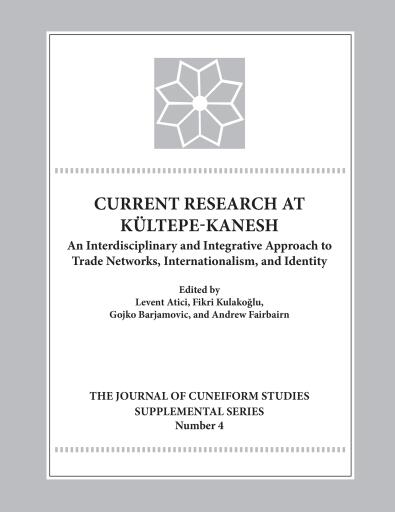
Current Research at Kultepe-Kanesh
Published by Lockwood Press
English
233 pages
2014
ISBN 9781937040208
Estimated reading time: 4 h 16 min
PDF
Buy at ebooks Libreria del GAM
🇨🇱
 Alpha Books
🇨🇴
Visit store →
Alpha Books
🇨🇴
Visit store →
 Bajalibros Argentina
🇦🇷
Visit store →
Bajalibros Argentina
🇦🇷
Visit store →
 Bajalibros Latam
🇺🇸
Visit store →
Bajalibros Latam
🇺🇸
Visit store →
 Bookshop Uruguay
🇺🇾
Visit store →
Bookshop Uruguay
🇺🇾
Visit store →
 Catademic
🇺🇸
Visit store →
Catademic
🇺🇸
Visit store →
Available at 14 bookshops
Alpha Books
🇨🇴
Visit store →
Bajalibros Argentina
🇦🇷
Visit store →
Bajalibros Latam
🇺🇸
Visit store →
Bookshop Uruguay
🇺🇾
Visit store →
Catademic
🇺🇸
Visit store →









About this book
The material remains and the more than 23,500 cuneiform tablets unearthed at the site of Kultepe (ancient Kanesh) shed light on social, political, and economic aspects of the Middle Bronze age (ca. 2000-1700 years BC) in central Anatolia, but also in Upper Mesopotamia. The rich textual record provides ample information on a very sophisticated supraregional market economy, representing one of the best-documented historical cases of long-distance trade in the ancient world. Although the site was first excavated in 1893, followed by intermittent excavations between 1906 and 2005, modern scientific and interdisciplinary excavations have only been undertaken since 2006. The new scientific research at Kultepe-Kanesh has already begun amassing new data and providing us with a unique opportunity to generate new perspectives and to challenge previous models and assumptions about, for example, trade, colonialism, ethnicity, art, religious ideas, identity, and patterns of social, political, and economic organization in the Near East during the Middle Bronze Age. A primary goal of this special volume is to integrate the work of scholars in archaeology, archaeometry, bioarchaeology, geoarchaeology, and history to develop a new synthetic research paradigm for investigating issues of trade, colonialism, ethnicity, art, identity, and urbanization in the Near East in a unified fashion.
Availability
Current Research at Kultepe-Kanesh is available as PDF at 14 online bookshops. Bookshops carrying it include Alpha Books, Bajalibros Argentina, Bajalibros Latam.
Genres
- Language
- English
Share
Frequently asked questions
- In what formats is Current Research at Kultepe-Kanesh available?
- Current Research at Kultepe-Kanesh is available as PDF at 14 online bookshops.
- Where can I buy Current Research at Kultepe-Kanesh?
- You can buy Current Research at Kultepe-Kanesh at Alpha Books, Bajalibros Argentina, Bajalibros Latam. Compare every option in the list on this page.
- How long does it take to read Current Research at Kultepe-Kanesh?
- At an average reading pace, Current Research at Kultepe-Kanesh takes about 4 h 16 min to read (233 pages).
Ratings & reviews
No ratings yet. Be the first to review this book.
Sign in to rate and review this book.