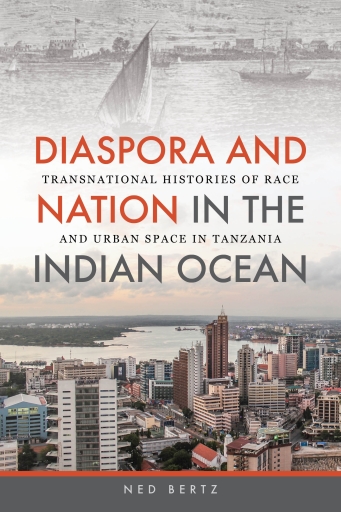
Diaspora and Nation in the Indian Ocean

Diaspora and Nation in the Indian Ocean

By Bertz, Ned

Published by University of Hawaii Press

English 289 pages 2015 ISBN 9780824857394
Estimated reading time: 5 h 18 min
PDF

About this book

The vibrant Swahili coast port city of Dar es Salaam—literally, the “Haven of Peace”—hosts a population reflecting a legacy of long relations with the Arabian Peninsula and a diaspora emanating in waves from the Indian subcontinent. By the 1960s, after decades of European imperial intrusions, Tanzanian nationalist forces had peacefully dismantled the last British colonial structures of racial segregation and put in place an official philosophy of nonracial nationalism. Yet today, more than five decades after independence, race is still a prominent and publicly contested subject in Dar es Salaam. What makes this issue so dizzyingly elusive—for government bureaucrats and ordinary people alike—is East Africa’s location on the Indian Ocean, a historic crossroads of diverse peoples possessing varied ideas about how to reconcile human difference, social belonging, and place of origin. Based on a range of archival, oral, and newspaper sources from Tanzania and India, this book explores the history of cross-cultural encounters that shaped regional ideas of diaspora and nationhood from the earliest days of colonial Tanganyika—when Indian settlement began to expand dramatically—to present-day Tanzania, a nation always under construction. The book focuses primarily on two prominent city spaces, schools and cinemas: the one a site of education, the other a site of leisure; one typically a programmatic entity of government, the other usually a bastion of commercial enterprise. Nonetheless, the forces shaping schools and cinemas as they developed into busy centers of urban social interaction were surprisingly similar: the state, community organizations, nationalist movements, economic change, and the transnational winds of Indian Ocean culture and capital. Whether in the form of institutional apparatuses like networks of Indian teacher importation and curricula adoption, or through the market predominance of the Indian film industry, schools and cinemas in East Africa historically were influenced by actions and ideas from around the Indian Ocean. Diaspora and Nation in the Indian Ocean argues that an Indian Ocean–wide perspective enables an examination of the transnational production of ideas about race against a backdrop of changing relationships and claims of belonging as new notions of nationhood and diaspora emerged. It bridges an academic divide, because historians often either focus on the Indian diaspora in isolation or write it out of the story of African nation building. Further, in contrast to the swell of publications on global Indian or South Asian diasporas that highlight longings for and contacts with the “homeland,” the book also demonstrates that much of the creative production of diasporic Indian identities formed in East Africa was a result of local (albeit cosmopolitan) encounters across cities like Dar es Salaam.

Availability

Diaspora and Nation in the Indian Ocean is available as PDF at 13 online bookshops. Bookshops carrying it include Association of University Presses - Tienda FILUNI, Bajalibros Argentina, Bajalibros Latam.

Language
English
Share

Frequently asked questions

In what formats is Diaspora and Nation in the Indian Ocean available?
Diaspora and Nation in the Indian Ocean is available as PDF at 13 online bookshops.
Where can I buy Diaspora and Nation in the Indian Ocean?
You can buy Diaspora and Nation in the Indian Ocean at Association of University Presses - Tienda FILUNI, Bajalibros Argentina, Bajalibros Latam. Compare every option in the list on this page.
How long does it take to read Diaspora and Nation in the Indian Ocean?
At an average reading pace, Diaspora and Nation in the Indian Ocean takes about 5 h 18 min to read (289 pages).

Ratings & reviews

No ratings yet. Be the first to review this book.

Sign in to rate and review this book.

Comments

Sign in to join the conversation.

No comments yet.