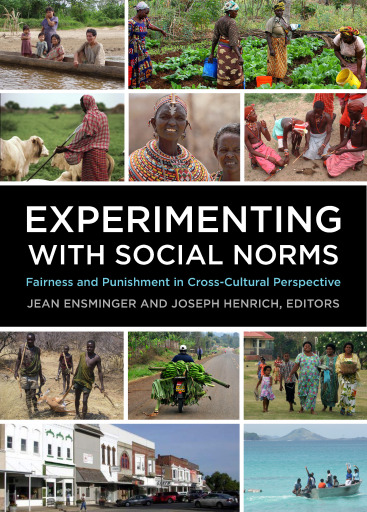
Experimenting with Social Norms
Published by Russell Sage Foundation
English
2014
ISBN 9781610448406
eBook
Buy at Association of University Presses - Tienda FILUNI
🇺🇸
 Bajalibros Argentina
🇦🇷
Visit store →
Bajalibros Argentina
🇦🇷
Visit store →
 Bajalibros Latam
🇺🇸
Visit store →
Bajalibros Latam
🇺🇸
Visit store →
 Bookshop Uruguay
🇺🇾
Visit store →
Bookshop Uruguay
🇺🇾
Visit store →
 Catademic
🇺🇸
Visit store →
Catademic
🇺🇸
Visit store →
Available at 13 bookshops
 Bajalibros Argentina
🇦🇷
Visit store →
Bajalibros Latam
🇺🇸
Visit store →
Bookshop Uruguay
🇺🇾
Visit store →
Catademic
🇺🇸
Visit store →
Bajalibros Argentina
🇦🇷
Visit store →
Bajalibros Latam
🇺🇸
Visit store →
Bookshop Uruguay
🇺🇾
Visit store →
Catademic
🇺🇸
Visit store →








About this book
Questions about the origins of human cooperation have long puzzled and divided scientists. Social norms that foster fair-minded behavior, altruism and collective action undergird the foundations of large-scale human societies, but we know little about how these norms develop or spread, or why the intensity and breadth of human cooperation varies among different populations. What is the connection between social norms that encourage fair dealing and economic growth? How are these social norms related to the emergence of centralized institutions? Informed by a pioneering set of cross-cultural data, Experimenting with Social Norms advances our understanding of the evolution of human cooperation and the expansion of complex societies. Editors Jean Ensminger and Joseph Henrich present evidence from an exciting collaboration between anthropologists and economists. Using experimental economics games, researchers examined levels of fairness, cooperation, and norms for punishing those who violate expectations of equality across a diverse swath of societies, from hunter-gatherers in Tanzania to a small town in rural Missouri. These experiments tested individuals’ willingness to conduct mutually beneficial transactions with strangers that reap rewards only at the expense of taking a risk on the cooperation of others. The results show a robust relationship between exposure to market economies and social norms that benefit the group over narrow economic self-interest. Levels of fairness and generosity are generally higher among individuals in communities with more integrated markets. Religion also plays a powerful role. Individuals practicing either Islam or Christianity exhibited a stronger sense of fairness, possibly because religions with high moralizing deities, equipped with ample powers to reward and punish, encourage greater prosociality. The size of the settlement also had an impact. People in larger communities were more willing to punish unfairness compared to those in smaller societies. Taken together, the volume supports the hypothesis that social norms evolved over thousands of years to allow strangers in more complex and large settlements to coexist, trade and prosper. Innovative and ambitious, Experimenting with Social Norms synthesizes an unprecedented analysis of social behavior from an immense range of human societies. The fifteen case studies analyzed in this volume, which include field experiments in Africa, South America, New Guinea, Siberia and the United States, are available for free download on the Foundation’s website:www.russellsage.org.
Availability
Experimenting with Social Norms is available as eBook at 13 online bookshops. Bookshops carrying it include Association of University Presses - Tienda FILUNI, Bajalibros Argentina, Bajalibros Latam.
- Language
- English
Share
Frequently asked questions
- In what formats is Experimenting with Social Norms available?
- Experimenting with Social Norms is available as eBook at 13 online bookshops.
- Where can I buy Experimenting with Social Norms?
- You can buy Experimenting with Social Norms at Association of University Presses - Tienda FILUNI, Bajalibros Argentina, Bajalibros Latam. Compare every option in the list on this page.
Ratings & reviews
No ratings yet. Be the first to review this book.
Sign in to rate and review this book.