
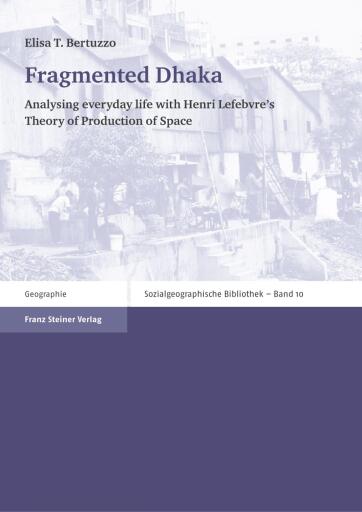
Fragmented Dhaka
Published by Franz Steiner Verlag GmbH
English
244 pages
2012
ISBN 9783515097512
PDF







About this book
Bangladesh's capital city Dhaka is one of the world's fastest growing cities, passing from a population of one million to twelve million people in its extended area within three decades (1970–2000). This confronts its inhabitants, observers as well as planners with contradictions that ask for redefining our ways of living in and thinking about the city.
In particular, Western conceptions of public space and urban societies are challenged by a symptomatic fragmentation.
This empirical study observes the megacity's everyday spaces and situations directly and with a non-generalising approach. By means of ethnographic field research it describes the production of "enriched" or multifunctional spaces through everyday life practices, recognising in the inhabitants' appropriation and adaptation processes a potential for sustainable mixed forms of urban development.
For the first time, Henri Lefebvre's theory of production of space is applied with all of its implications to an empirical study. City and urbanity emerge then as the result of three continuously interacting and interdependent production processes: physical, mental and social.
Genres
- Language
- English
Share
You might also like
Precipitação Máxima Anual em Petrópolis
Valéria, Sandra
Identität – Repräsentation – Diskurs
Marxhausen, Christiane
Fenomenologia do ser-situado
Marandola Jr., Eduardo
Informal Modes of Governance in Customer Producer Relations
Meyer, Susanne
A geografia da transposição de rios
Assis, André Tomé De
Gesundheitliche Disparitäten im urbanen Indien
Kroll, Mareike