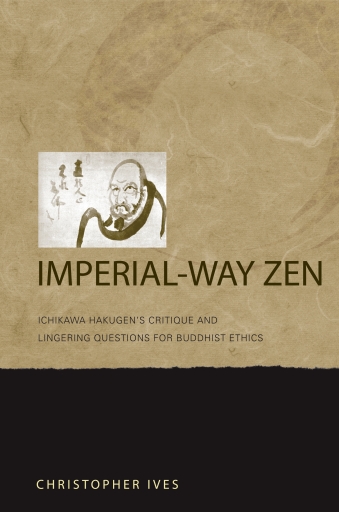
Imperial-Way Zen
Published by University of Hawaii Press
English
289 pages
2009
ISBN 9780824862961
Estimated reading time: 5 h 18 min
PDF
Buy at Bookshop Uruguay
🇺🇾
 Association of University Presses - Tienda FILUNI
🇺🇸
Visit store →
Association of University Presses - Tienda FILUNI
🇺🇸
Visit store →
 Bajalibros Argentina
🇦🇷
Visit store →
Bajalibros Argentina
🇦🇷
Visit store →
 Bajalibros Latam
🇺🇸
Visit store →
Bajalibros Latam
🇺🇸
Visit store →
 Catademic
🇺🇸
Visit store →
Catademic
🇺🇸
Visit store →
Available at 13 bookshops
Association of University Presses - Tienda FILUNI
🇺🇸
Visit store →
Bajalibros Argentina
🇦🇷
Visit store →
Bajalibros Latam
🇺🇸
Visit store →
 Catademic
🇺🇸
Visit store →
Catademic
🇺🇸
Visit store →








About this book
During the first half of the twentieth century, Zen Buddhist leaders contributed actively to Japanese imperialism, giving rise to what has been termed "Imperial-Way Zen" (Kodo Zen). Its foremost critic was priest, professor, and activist Ichikawa Hakugen (1902–1986), who spent the decades following Japan’s surrender almost single-handedly chronicling Zen’s support of Japan’s imperialist regime and pressing the issue of Buddhist war responsibility. Ichikawa focused his critique on the Zen approach to religious liberation, the political ramifications of Buddhist metaphysical constructs, the traditional collaboration between Buddhism and governments in East Asia, the philosophical system of Nishida Kitaro (1876–1945), and the vestiges of State Shinto in postwar Japan.
Despite the importance of Ichikawa’s writings, this volume is the first by any scholar to outline his critique. In addition to detailing the actions and ideology of Imperial-Way Zen and Ichikawa’s ripostes to them, Christopher Ives offers his own reflections on Buddhist ethics in light of the phenomenon. He devotes chapters to outlining Buddhist nationalism from the 1868 Meiji Restoration to 1945 and summarizing Ichikawa’s arguments about the causes of Imperial-Way Zen. After assessing Brian Victoria’s claim that Imperial-Way Zen was caused by the traditional connection between Zen and the samurai, Ives presents his own argument that Imperial-Way Zen can best be understood as a modern instance of Buddhism’s traditional role as protector of the realm. Turning to postwar Japan, Ives examines the extent to which Zen leaders have reflected on their wartime political stances and started to construct a critical Zen social ethic. Finally, he considers the resources Zen might offer its contemporary leaders as they pursue what they themselves have identified as a pressing task: ensuring that henceforth Zen will avoid becoming embroiled in international adventurism and instead dedicate itself to the promotion of peace and human rights.
Lucid and balanced in its methodology and well grounded in textual analysis, Imperial-Way Zen will attract scholars, students, and others interested in Buddhism, ethics, Zen practice, and the cooptation of religion in the service of violence and imperialism.
Availability
Imperial-Way Zen is available as PDF at 13 online bookshops. Bookshops carrying it include Association of University Presses - Tienda FILUNI, Bajalibros Argentina, Bajalibros Latam.
- Language
- English
Share
Frequently asked questions
- In what formats is Imperial-Way Zen available?
- Imperial-Way Zen is available as PDF at 13 online bookshops.
- Where can I buy Imperial-Way Zen?
- You can buy Imperial-Way Zen at Association of University Presses - Tienda FILUNI, Bajalibros Argentina, Bajalibros Latam. Compare every option in the list on this page.
- How long does it take to read Imperial-Way Zen?
- At an average reading pace, Imperial-Way Zen takes about 5 h 18 min to read (289 pages).
Ratings & reviews
No ratings yet. Be the first to review this book.
Sign in to rate and review this book.