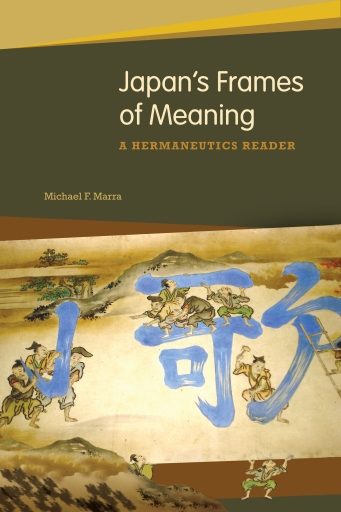
Japan’s Frames of Meaning
Published by University of Hawaii Press
English
465 pages
2010
ISBN 9780824860769
Estimated reading time: 8 h 32 min
PDF
Buy at ebookskitapenas
🇬🇹
 Association of University Presses - Tienda FILUNI
🇺🇸
Visit store →
Association of University Presses - Tienda FILUNI
🇺🇸
Visit store →
 Bajalibros Argentina
🇦🇷
Visit store →
Bajalibros Argentina
🇦🇷
Visit store →
 Bajalibros Latam
🇺🇸
Visit store →
Bajalibros Latam
🇺🇸
Visit store →
 Bookshop Uruguay
🇺🇾
Visit store →
Bookshop Uruguay
🇺🇾
Visit store →
 Catademic
🇺🇸
Visit store →
Catademic
🇺🇸
Visit store →
Available at 13 bookshops
Association of University Presses - Tienda FILUNI
🇺🇸
Visit store →
Bajalibros Argentina
🇦🇷
Visit store →
Bajalibros Latam
🇺🇸
Visit store →
Bookshop Uruguay
🇺🇾
Visit store →
Catademic
🇺🇸
Visit store →








About this book
In Japan’s Frames of Meaning, Michael Marra identifies interpretative concepts central to discussions of hermeneutical practices in Japan and presents English translations of works on basic hermeneutics by major Japanese thinkers. Discussions of Japanese thought tend to be centered on key Western terms in light of which Japanese texts are examined; alternatively, a few Buddhist concepts are presented as counterparts of these Western terms. Marra concentrates on Japanese philosophers and thinkers who have mediated these two extremes, bringing their knowledge of Western thought to bear on philosophical reinterpretations of Buddhist terms that are, thus, presented in secularized form.
Marra focuses on categories relevant to the development of a history of Japanese hermeneutics, calling attention to concepts whose discussion sheds light on how Japanese thinkers have proceeded in making sense of their own culture. The terms are organized under three headings. The first deals with koto, which in Japanese means both "things" and "words." Koto is the center of a series of interesting compounds, such as kotodama (the spirit of words) and makoto (truth), that have shaped Japanese discourses on philosophy, ethics, aesthetics, and religion. Writings on koto by twentieth-century philosophers Watsuji Tetsuro (1889–1960) and Omori Shozo (1921–1997) and Edo-period scholar Fujitani Mitsue (1768–1823) are included. The second heading is dedicated to two well-known aesthetic categories, yugen and sabi, which point to notions of depth in physical space as well as in the space of interiority. The University of Kyoto aesthetician Ueda Juzo (1886–1973) guides the reader through a history of these concepts. In the third part of the book, notions of time in the form of ku (emptiness) and guzen (contingency) are examined through the work of Ueda’s colleagues at Kyoto, Nishitani Keiji (1900–1990) and Kuki Shuzo (1888–1941).
Perceptive and erudite, Japan’s Frames of Meaning will become a landmark resource—in particular for the insights and provocations it offers to contemporary cross-cultural philosophical dialogue—for anyone interested in traditional and modern Japanese thought.
Availability
Japan’s Frames of Meaning is available as PDF at 13 online bookshops. Bookshops carrying it include Association of University Presses - Tienda FILUNI, Bajalibros Argentina, Bajalibros Latam.
- Language
- English
Share
Frequently asked questions
- In what formats is Japan’s Frames of Meaning available?
- Japan’s Frames of Meaning is available as PDF at 13 online bookshops.
- Where can I buy Japan’s Frames of Meaning?
- You can buy Japan’s Frames of Meaning at Association of University Presses - Tienda FILUNI, Bajalibros Argentina, Bajalibros Latam. Compare every option in the list on this page.
- How long does it take to read Japan’s Frames of Meaning?
- At an average reading pace, Japan’s Frames of Meaning takes about 8 h 32 min to read (465 pages).
Ratings & reviews
No ratings yet. Be the first to review this book.
Sign in to rate and review this book.