
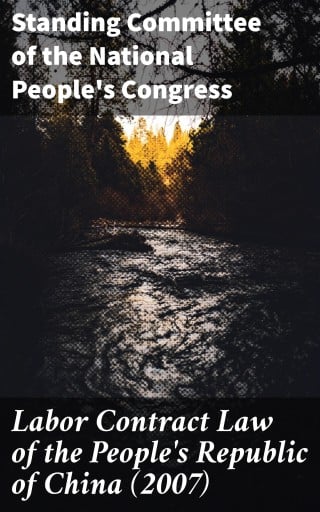
Labor Contract Law of the People's Republic of China (2007)
By Standing Committee of the National People's Congress
Published by Good Press
English
2021
ISBN 4064066467036
eBook
Buy at Bajalibros Latam
🇺🇸
 Bajalibros Latam
🇺🇸
Visit store →
Bajalibros Latam
🇺🇸
Visit store →
 LORANCHBOOKSTORE
🇺🇸
Visit store →
LORANCHBOOKSTORE
🇺🇸
Visit store →
 Libros Patagonia
🇨🇱
Visit store →
Libros Patagonia
🇨🇱
Visit store →
 Ebooks Librería Carlos Fuentes
🇲🇽
Visit store →
Ebooks Librería Carlos Fuentes
🇲🇽
Visit store →
 Ebooks Librería Antártica
🇨🇱
Visit store →
Ebooks Librería Antártica
🇨🇱
Visit store →
 Ebooks Happy Books
🇨🇴
Visit store →
Ebooks Happy Books
🇨🇴
Visit store →
 ebooks libreria española
🇪🇨
Visit store →
ebooks libreria española
🇪🇨
Visit store →
 Bajalibros Argentina
🇦🇷
Visit store →
Bajalibros Argentina
🇦🇷
Visit store →
 Alpha Books
🇨🇴
Visit store →
Alpha Books
🇨🇴
Visit store →
 Sanborns Ebooks
🇲🇽
Visit store →
Sanborns Ebooks
🇲🇽
Visit store →
 ebooks Libreria del GAM
🇨🇱
Visit store →
ebooks Libreria del GAM
🇨🇱
Visit store →
 Bookshop Uruguay
🇺🇾
Visit store →
Bookshop Uruguay
🇺🇾
Visit store →
 Ebooks Yenny - El Ateneo
🇦🇷
Visit store →
Ebooks Yenny - El Ateneo
🇦🇷
Visit store →
 Crisol Ebooks
🇵🇪
Visit store →
Crisol Ebooks
🇵🇪
Visit store →
Available at 14 bookshops
Bajalibros Latam
🇺🇸
Visit store →
LORANCHBOOKSTORE
🇺🇸
Visit store →
Libros Patagonia
🇨🇱
Visit store →
Ebooks Librería Carlos Fuentes
🇲🇽
Visit store →
Ebooks Librería Antártica
🇨🇱
Visit store →
Ebooks Happy Books
🇨🇴
Visit store →
ebooks libreria española
🇪🇨
Visit store →
Bajalibros Argentina
🇦🇷
Visit store →
Alpha Books
🇨🇴
Visit store →
Sanborns Ebooks
🇲🇽
Visit store →
ebooks Libreria del GAM
🇨🇱
Visit store →
Bookshop Uruguay
🇺🇾
Visit store →
Ebooks Yenny - El Ateneo
🇦🇷
Visit store →
Crisol Ebooks
🇵🇪
Visit store →
About this book
The "Labor Contract Law of the People's Republic of China (2007)" represents a pivotal legislative framework aimed at regulating labor relations within China's rapidly evolving market economy. Written in a clear and accessible style, the law serves not only as a legal document but also as a sociopolitical commentary on the necessity of defined labor rights amidst significant economic shifts. Contextually, it emerges from the backdrop of China'Äôs transition from a planned economy to one more aligned with capitalist principles, addressing the complexities of employment contracts, employer obligations, and workers' rights in a nation striving for both modernization and stability. The Standing Committee of the National People's Congress, the authoritative body behind this legislation, reflects the concerted effort by the Chinese government to codify labor relations in a manner that balances the interests of both workers and employers. This law was driven by increasing concerns over labor unrest and the need for a more structured legal framework to secure fair treatment for workers. Its enactment embodies the tension between economic growth and the social implications of such transitions, as well as the government's recognition of the importance of labor laws for sustainable development. For those interested in labor rights, Chinese legal history, or the socio-economic implications of legislation, this law is an essential read. It provides valuable insight into the fundamental shifts in China's labor environment and illustrates the balance of power that defines contemporary Chinese labor relations. By exploring this document, readers can better understand the complexities and ongoing challenges facing labor in one of the world's largest economies.
Genres
- Language
- English
Share
You might also like

Fraudes Nas Transações Imobiliárias
Vinholi, Marcelo Saraiva
Obligaciones alternativas en el derecho latinoamericano: un análisis a partir de la regla de integridad del pago
Salgado Ramírez, Catalina

Violencia intrafamiliar en Bogotá contra la mujer
Rojas G., Clara L.

Minhas Anotações
Machado, Eduardo Lopes
Das Spannungsfeld Windenergieanlagen - Drehfunkfeuer
Josipovic, Neven
Artenschutzrechtliche Erfordernisse bei der Genehmigung von Windenergieanlagen
Brandt, Edmund