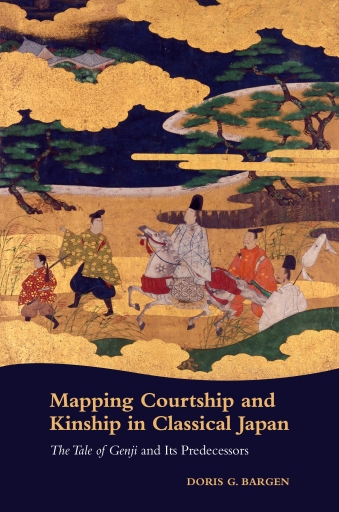
Mapping Courtship and Kinship in Classical Japan
Published by University of Hawaii Press
English
401 pages
2015
ISBN 9780824857332
Estimated reading time: 7 h 21 min
PDF
Buy at Viubux
🇲🇽
 Association of University Presses - Tienda FILUNI
🇺🇸
Visit store →
Association of University Presses - Tienda FILUNI
🇺🇸
Visit store →
 Bajalibros Argentina
🇦🇷
Visit store →
Bajalibros Argentina
🇦🇷
Visit store →
 Bajalibros Latam
🇺🇸
Visit store →
Bajalibros Latam
🇺🇸
Visit store →
 Bookshop Uruguay
🇺🇾
Visit store →
Bookshop Uruguay
🇺🇾
Visit store →
 Catademic
🇺🇸
Visit store →
Catademic
🇺🇸
Visit store →
Available at 13 bookshops
Association of University Presses - Tienda FILUNI
🇺🇸
Visit store →
Bajalibros Argentina
🇦🇷
Visit store →
Bajalibros Latam
🇺🇸
Visit store →
Bookshop Uruguay
🇺🇾
Visit store →
Catademic
🇺🇸
Visit store →








About this book
Literary critiques of Murasaki Shikibu's eleventh-century The Tale of Genji have often focused on the amorous adventures of its eponymous hero. In this paradigm-shifting analysis of the Genji and other mid-Heian literature, Doris G. Bargen emphasizes the thematic importance of Japan’s complex polygynous kinship system as the domain within which courtship occurs. Heian courtship, conducted mainly to form secondary marriages, was driven by power struggles of succession among lineages that focused on achieving the highest position possible at court. Thus interpreting courtship in light of genealogies is essential for comprehending the politics of interpersonal behavior in many of these texts. Bargen focuses on the genealogical maze—the literal and figurative space through which several generations of men and women in the Genji moved. She demonstrates that courtship politics sought to control kinship by strengthening genealogical lines, while secret affairs and illicit offspring produced genealogical uncertainty that could be dealt with only by reconnecting dissociated lineages or ignoring or even terminating them.
The work examines in detail the literary construction of a courtship practice known as kaimami, or “looking through a gap in the fence,” in pre-Genji tales and diaries, and Sei Shōnagon’s famous Pillow Book. In Murasaki Shikibu’s Genji, courtship takes on multigenerational complexity and is often used as a political strategy to vindicate injustices, counteract sexual transgressions, or resist the pressure of imperial succession. Bargen argues persuasively that a woman observed by a man was not wholly deprived of agency: She could choose how much to reveal or conceal as she peeked through shutters, from behind partitions, fans, and kimono sleeves, or through narrow carriage windows. That mid-Heian authors showed courtship in its innumerable forms as being influenced by the spatial considerations of the Heian capital and its environs and by the architectural details of the residences within which aristocratic women were sequestered adds a fascinating topographical dimension to courtship. In Mapping Courtship and Kinship in Classical Japan readers both familiar with and new to The Tale of Genji and its predecessors will be introduced to a wholly new interpretive lens through which to view these classic texts. In addition, the book includes charts that trace Genji characters’ lineages, maps and diagrams that plot the movements of courtiers as they make their way through the capital and beyond, and color reproductions of paintings that capture the drama of courtship.
Availability
Mapping Courtship and Kinship in Classical Japan is available as PDF at 13 online bookshops. Bookshops carrying it include Association of University Presses - Tienda FILUNI, Bajalibros Argentina, Bajalibros Latam.
Genres
- Language
- English
Share
Frequently asked questions
- In what formats is Mapping Courtship and Kinship in Classical Japan available?
- Mapping Courtship and Kinship in Classical Japan is available as PDF at 13 online bookshops.
- Where can I buy Mapping Courtship and Kinship in Classical Japan?
- You can buy Mapping Courtship and Kinship in Classical Japan at Association of University Presses - Tienda FILUNI, Bajalibros Argentina, Bajalibros Latam. Compare every option in the list on this page.
- How long does it take to read Mapping Courtship and Kinship in Classical Japan?
- At an average reading pace, Mapping Courtship and Kinship in Classical Japan takes about 7 h 21 min to read (401 pages).
Ratings & reviews
No ratings yet. Be the first to review this book.
Sign in to rate and review this book.