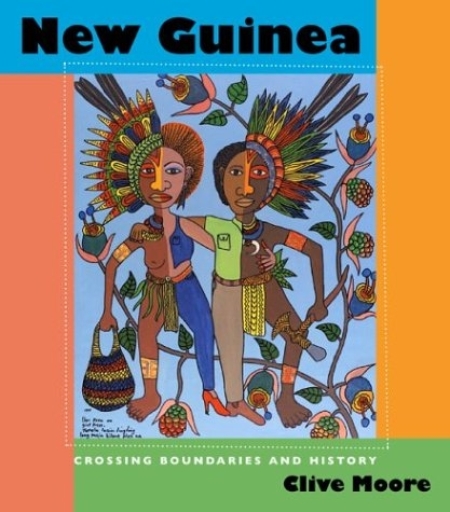
New Guinea
By Moore, Clive
Published by University of Hawaii Press
English
288 pages
2003
ISBN 9780824844134
Estimated reading time: 5 h 17 min
PDF
Buy at Bookshop Uruguay
🇺🇾
 Association of University Presses - Tienda FILUNI
🇺🇸
Visit store →
Association of University Presses - Tienda FILUNI
🇺🇸
Visit store →
 Bajalibros Argentina
🇦🇷
Visit store →
Bajalibros Argentina
🇦🇷
Visit store →
 Bajalibros Latam
🇺🇸
Visit store →
Bajalibros Latam
🇺🇸
Visit store →
 Catademic
🇺🇸
Visit store →
Catademic
🇺🇸
Visit store →
Available at 13 bookshops
Association of University Presses - Tienda FILUNI
🇺🇸
Visit store →
Bajalibros Argentina
🇦🇷
Visit store →
Bajalibros Latam
🇺🇸
Visit store →
 Catademic
🇺🇸
Visit store →
Catademic
🇺🇸
Visit store →








About this book
New Guinea, the world's largest tropical island, is a land of great contrasts, ranging from small glaciers on its highest peaks to broad mangrove swamps in its lowlands and hundreds of smaller islands and coral atolls along its coasts. Divided between two nations, the island and its neighboring archipelagos form Indonesia’s Papua Province (or Irian Jaya) and the independent nation of Papua New Guinea, both former European colonies. Most books on New Guinea have been guided by these and other divisions, separating east from west, prehistoric from historic, precontact from postcontact, colonial from postcolonial.
This is the first work to consider New Guinea and its 40,000-year history in its entirety. The volume opens with a look at the Melanesian region and argues that interlocking exchange systems and associated human interchanges are the "invisible government" through which New Guinea societies operate. Succeeding chapters review the history of encounters between outsiders and New Guinea's populations. They consider the history of Malay involvement with New Guinea over the past two thousand years, demonstrating the extent to which west New Guinea in particular was incorporated into Malay trading and raiding networks prior to Western contact. The impact of colonial rule, economic and social change, World War II, decolonization, and independence are discussed in the final chapter.
Availability
New Guinea is available as PDF at 13 online bookshops. Bookshops carrying it include Association of University Presses - Tienda FILUNI, Bajalibros Argentina, Bajalibros Latam.
Genres
- Language
- English
Share
Frequently asked questions
- In what formats is New Guinea available?
- New Guinea is available as PDF at 13 online bookshops.
- Where can I buy New Guinea?
- You can buy New Guinea at Association of University Presses - Tienda FILUNI, Bajalibros Argentina, Bajalibros Latam. Compare every option in the list on this page.
- How long does it take to read New Guinea?
- At an average reading pace, New Guinea takes about 5 h 17 min to read (288 pages).
Ratings & reviews
No ratings yet. Be the first to review this book.
Sign in to rate and review this book.