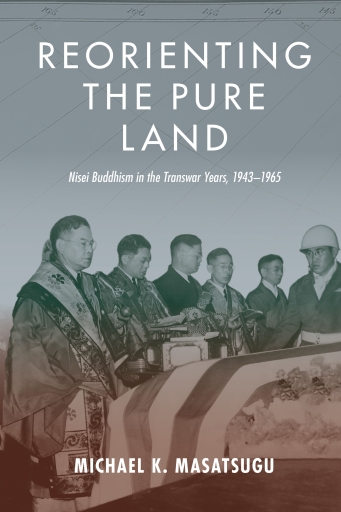
Reorienting the Pure Land

Reorienting the Pure Land

By Masatsugu, Michael Kenji

Published by University of Hawaii Press

English 273 pages 2023 ISBN 9780824896577
Estimated reading time: 5 h
PDF

About this book

Post–World War II historical developments, including Japanese American resettlement, the US occupation of Japan, the Cold War, and decolonization in an emerging “Third World,” created both a climate of uncertainty and possibility for the future of Japanese American Buddhism in the United States. As both a racial minority and as adherents of a non-Christian religious tradition with roots in Asia, Nikkei Buddhists faced distinct challenges in asserting their religion as part of their ethnic heritage. Adaptations associated with Nisei Buddhism sought to prioritize cultural assimilation as prescribed by US government officials and other proponents of racial liberalism, while also seeking to maintain Shin Buddhist tradition, claiming it as integral to Nikkei heritage and part of a tradition of American religious freedom. Nisei also presented Buddhism as a world religion, which served as more than a rhetorical strategy, since many Nisei extended their vision of the sangha (community of Buddhists) to include connections with Buddhists in Japan and South and Southeast Asia. But Nisei Buddhism's emerging influence among American Shin Buddhist communities would be challenged by converts and a younger generation of more progressive Nikkei during the 1960s. Reorienting the Pure Land is the first historical study of Nisei Shin Buddhists in the United States during the tumultuous period between World War II and the early decades of the Cold War. This book examines Nisei-led adaptations to American Shin Buddhist institutions and organizations in an effort to reconstitute Nikkei Buddhist communities following the end of World War II and release from US-government-sponsored concentration camps. Taking a transnational perspective, this text establishes the importance of Buddhism in shaping networks in the United States and across the globe, and is the first to highlight the centrality of ethnic Buddhism in building the terms of racial inclusion and the construction of Asian Americans as a model minority. In addressing themes of religious adaptation, cultural nationalism, and global connection, Reorienting the Pure Land makes new contributions to the fields of Japanese American history, the history of Buddhism in America, and the study of Cold War racial liberalism.

Availability

Reorienting the Pure Land is available as PDF at 13 online bookshops. Bookshops carrying it include Association of University Presses - Tienda FILUNI, Bajalibros Argentina, Bajalibros Latam.

Language
English
Share

Frequently asked questions

In what formats is Reorienting the Pure Land available?
Reorienting the Pure Land is available as PDF at 13 online bookshops.
Where can I buy Reorienting the Pure Land?
You can buy Reorienting the Pure Land at Association of University Presses - Tienda FILUNI, Bajalibros Argentina, Bajalibros Latam. Compare every option in the list on this page.
How long does it take to read Reorienting the Pure Land?
At an average reading pace, Reorienting the Pure Land takes about 5 h to read (273 pages).

Ratings & reviews

No ratings yet. Be the first to review this book.

Sign in to rate and review this book.

Comments

Sign in to join the conversation.

No comments yet.