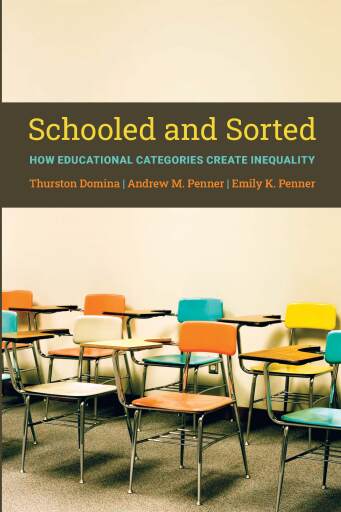
Schooled and Sorted
By Domina, Thurston, Penner, Andrew M., Penner, Emily K.
Published by Russell Sage Foundation
English
2023
ISBN 9781610449021
eBook
Buy at Catademic
🇺🇸
Catademic
🇺🇸
Visit store →
Bajalibros Latam
🇺🇸
Visit store →
Association of University Presses - Tienda FILUNI
🇺🇸
Visit store →

Ebooks Librería Antártica
🇨🇱
Visit store →
Ebooks Agustin
🇪🇸
Visit store →
Bajalibros Argentina
🇦🇷
Visit store →

Sanborns Ebooks
🇲🇽
Visit store →
ebooks Libreria del GAM
🇨🇱
Visit store →
Bookshop Uruguay
🇺🇾
Visit store →

ebookskitapenas
🇬🇹
Visit store →
Ebooks Yenny - El Ateneo
🇦🇷
Visit store →
Crisol Ebooks
🇵🇪
Visit store →
Available at 12 bookshops
Catademic
🇺🇸
Visit store →
Association of University Presses - Tienda FILUNI
🇺🇸
Visit store →
Ebooks Librería Antártica
🇨🇱
Visit store →
Ebooks Agustin
🇪🇸
Visit store →
Sanborns Ebooks
🇲🇽
Visit store →
ebooks Libreria del GAM
🇨🇱
Visit store →
ebookskitapenas
🇬🇹
Visit store →
Ebooks Yenny - El Ateneo
🇦🇷
Visit store →
Crisol Ebooks
🇵🇪
Visit store →
About this book
We tend to view education primarily as a way to teach students skills and knowledge that they will draw upon as they move into their adult lives. However, schools do more than educate students—they also place students into categories, such as kindergartner, English language learner, or honor roll student. In <i>Schooled & Sorted,</i> Thurston Domina, Andrew M. Penner, and Emily K. Penner, explore processes of educational categorization in order to explain the complex relationship between education and social inequality—and to identify strategies that can help build more just educational systems.<br> <br> Some educational categories have broadly egalitarian consequences. Indeed, Domina, Penner, and Penner argue that when societies enroll young people in school, making them <i>students</i>, they mark them as individuals who are worthy of rights. But other educational categories reinforce powerful social categories—including race, gender, and class—and ultimately reproduce social and economic inequality in society. Elite colleges, tracked high schools, and elementary school gifted programs provide not only different educational experiences, but also create merit and inequality by sorting students into categories that are defined by the students who are excluded.<br> <br> <i>Schooled & Sorted</i> highlights that many of the decisions that define educational categories occur in school-based committee meetings and other relatively local settings. The local nature of these decisions provides many opportunities to define educational categories differently, and for school communities to bring about change.<br> <br> <i>Schooled & Sorted</i> is an illuminating investigation into the ways sorting within schools translates into inequality in the larger world. While some educational categorization may be unavoidable, the authors suggest ways to build a more equitable system—and thus a more equitable society.<br>
- Language
- English
Share
You might also like
Cómo aprenden los seres humanos
Jaime Bermeosolo Bertrán
MENTE RAPIDA 10EGB
MENTE RAPIDA 1 EGB
Da sagrada missão pedagógica
Lopes, Eliane Marta Teixeira
Eu [não] sei!
Silva, Marlene Maria Machado da
A Participação das Crianças no Processo de Aprendizagemensino – Uma Pesquisa Sobre a Própria Prática
Silva, Leticia Roberta G. M. da