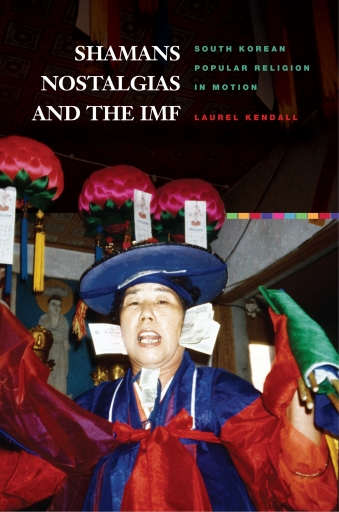
Shamans, Nostalgias, and the IMF
Published by University of Hawaii Press
English
281 pages
2009
ISBN 9780824860899
Estimated reading time: 5 h 9 min
PDF
Buy at Ebooks Yenny - El Ateneo
🇦🇷
 Association of University Presses - Tienda FILUNI
🇺🇸
Visit store →
Association of University Presses - Tienda FILUNI
🇺🇸
Visit store →
 Bajalibros Argentina
🇦🇷
Visit store →
Bajalibros Argentina
🇦🇷
Visit store →
 Bajalibros Latam
🇺🇸
Visit store →
Bajalibros Latam
🇺🇸
Visit store →
 Bookshop Uruguay
🇺🇾
Visit store →
Bookshop Uruguay
🇺🇾
Visit store →
 Catademic
🇺🇸
Visit store →
Catademic
🇺🇸
Visit store →
Available at 13 bookshops
Association of University Presses - Tienda FILUNI
🇺🇸
Visit store →
Bajalibros Argentina
🇦🇷
Visit store →
Bajalibros Latam
🇺🇸
Visit store →
Bookshop Uruguay
🇺🇾
Visit store →
Catademic
🇺🇸
Visit store →








About this book
Thirty years ago, anthropologist Laurel Kendall did intensive fieldwork among South Korea’s (mostly female) shamans and their clients as a reflection of village women’s lives. In the intervening decades, South Korea experienced an unprecedented economic, social, political, and material transformation and Korean villages all but disappeared. And the shamans? Kendall attests that they not only persist but are very much a part of South Korean modernity.
This enlightening and entertaining study of contemporary Korean shamanism makes the case for the dynamism of popular religious practice, the creativity of those we call shamans, and the necessity of writing about them in the present tense. Shamans thrive in South Korea’s high-rise cities, working with clients who are largely middle class and technologically sophisticated. Emphasizing the shaman’s work as open and mutable, Kendall describes how gods and ancestors articulate the changing concerns of clients and how the ritual fame of these transactions has itself been transformed by urban sprawl, private cars, and zealous Christian proselytizing.
For most of the last century Korean shamans were reviled as practitioners of antimodern superstition; today they are nostalgically celebrated icons of a vanished rural world. Such superstition and tradition occupy flip sides of modernity’s coin—the one by confuting, the other by obscuring, the beating heart of shamanic practice. Kendall offers a lively account of shamans, who once ministered to the domestic crises of farmers, as they address the anxieties of entrepreneurs whose dreams of wealth are matched by their omnipresent fears of ruin. Money and access to foreign goods provoke moral dilemmas about getting and spending; shamanic rituals express these through the longings of the dead and the playful antics of greedy gods, some of whom have acquired a taste for imported whiskey.
No other book-length study captures the tension between contemporary South Korean life and the contemporary South Korean shamans’ work. Kendall’s familiarity with the country and long association with her subjects permit nuanced comparisons between a 1970s "then" and recent encounters—some with the same shamans and clients—as South Korea moved through the 1990s, endured the Asian Financial Crisis, and entered the new millennium. She approaches her subject through multiple anthropological lenses such that readers interested in religion, ritual performance, healing, gender, landscape, material culture, modernity, and consumption will find much of interest here.
Availability
Shamans, Nostalgias, and the IMF is available as PDF at 13 online bookshops. Bookshops carrying it include Association of University Presses - Tienda FILUNI, Bajalibros Argentina, Bajalibros Latam.
- Language
- English
Share
Frequently asked questions
- In what formats is Shamans, Nostalgias, and the IMF available?
- Shamans, Nostalgias, and the IMF is available as PDF at 13 online bookshops.
- Where can I buy Shamans, Nostalgias, and the IMF?
- You can buy Shamans, Nostalgias, and the IMF at Association of University Presses - Tienda FILUNI, Bajalibros Argentina, Bajalibros Latam. Compare every option in the list on this page.
- How long does it take to read Shamans, Nostalgias, and the IMF?
- At an average reading pace, Shamans, Nostalgias, and the IMF takes about 5 h 9 min to read (281 pages).
Ratings & reviews
No ratings yet. Be the first to review this book.
Sign in to rate and review this book.