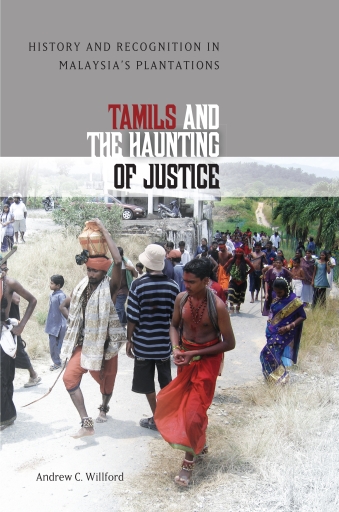
Tamils and the Haunting of Justice

Tamils and the Haunting of Justice

By Willford, Andrew C.

Published by University of Hawaii Press

English 2014 ISBN 9780824853044
eBook

About this book

In 2006 dejected members of the Bukit Jalil Estate community faced eviction from their homes in Kuala Lumpur where they had lived for generations. City officials classified plantation residents as squatters and, unaware of years of toil, attachment to the land, and past official promises, questioned any right they might have to stay, wondering “How can there be a plantation in Kuala Lumpur?” This story epitomizes the dilemma faced by Malaysian Tamils in recent years as they confront the moment when the plantation system where they have lived and worked for generations finally collapses. Foreign workers from Indonesia and Bangladesh have been brought in to replace Tamil workers to cut labor costs. As the new migrant workers do not bring their whole families with them, the community structures—schools, temples, churches, community halls, recreational fields—need no longer be sustained, allowing more land to be converted to mechanized palm oil production or lucrative housing developments. In short, the old, long-term community-based model of rubber plantation production introduced by British and French companies in colonial Malaya has been replaced by a model based upon migrant labor, mechanization, and a gradual contraction of the plantation economy. Tamils find themselves increasingly resentful of the fact that lands that were developed and populated by their ancestors are now claimed by Malays as their own; and that the land use patterns in these new townships, are increasingly hostile to the most symbolic vestiges of the Tamil and Hindu presence, the temples. In addition to issues pertaining to land, legal cases surrounding religious conversion have exacerbated a sense of insecurity among Tamil Hindus. Based on seventeen months of ethnographic fieldwork, this compelling book is about much more than the fast-approaching end to a way of life. Tamils and the Haunting of Justice addresses critical issues in the study of race and ethnicity. It is a study of how notions of justice, as imagined by an aggrieved minority, complicate legal demarcations of ethnic difference in post colonial states. Through its ethnographic breadth, it demonstrates which strategies, as enacted by local communities in conjunction with NGOs and legal advisors/activists, have been most “successful” in navigating the legal and political system of ethnic entitlement and compensation. It shows how, through a variety of strategies, Tamils try to access justice beyond the law—sometimes by using the law, and sometimes by turning to religious symbols and rituals in the murky space between law and justice. The book will thus appeal not only to scholars of Southeast Asia and the Indian diaspora, but also to ethnic studies and development scholars and those interested in postcolonial nationalism.

Availability

Tamils and the Haunting of Justice is available as eBook at 13 online bookshops. Bookshops carrying it include Association of University Presses - Tienda FILUNI, Bajalibros Argentina, Bajalibros Latam.

Language
English
Share

Frequently asked questions

In what formats is Tamils and the Haunting of Justice available?
Tamils and the Haunting of Justice is available as eBook at 13 online bookshops.
Where can I buy Tamils and the Haunting of Justice?
You can buy Tamils and the Haunting of Justice at Association of University Presses - Tienda FILUNI, Bajalibros Argentina, Bajalibros Latam. Compare every option in the list on this page.

Ratings & reviews

No ratings yet. Be the first to review this book.

Sign in to rate and review this book.

Comments

Sign in to join the conversation.

No comments yet.