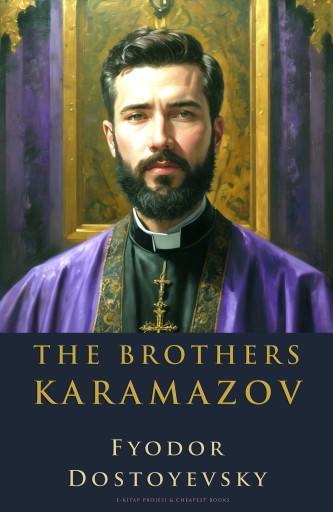
The Brothers Karamazov

The Brothers Karamazov

By Dostoyevsky, Fyodor

Published by E-Kitap Projesi & Cheapest Books

English 2024 ISBN 9786155564826
eBook

About this book

he Brothers Karamazov, is the final novel by the Russian author Fyodor Dostoyevsky. Dostoyevsky spent nearly two years writing The Brothers Karamazov, which was published as a serial in The Russian Messenger and completed in November 1880. Dostoyevsky intended it to be the first part in an epic story titled The Life of a Great Sinner, but he died less than four months after its publication. The Brothers Karamazov is a passionate philosophical novel set in 19th century Russia, that enters deeply into the ethical debates of God, free will, and morality. It is a spiritual drama of moral struggles concerning faith, doubt, and reason, set against a modernizing Russia. Dostoyevsky composed much of the novel in Staraya Russa, which inspired the main setting. Since its publication, it has been acclaimed as one of the supreme achievements in literature. Although written in the 19th century, The Brothers Karamazov displays a number of modern elements. Dostoyevsky composed the book with a variety of literary techniques. Though privy to many of the thoughts and feelings of the protagonists, the narrator is a self-proclaimed writer; he discusses his own mannerisms and personal perceptions so often in the novel that he becomes a character. Through his descriptions, the narrator's voice merges imperceptibly into the tone of the people he is describing, often extending into the characters' most personal thoughts. There is no voice of authority in the story (see Mikhail Bakhtin's Problems of Dostoyevsky's Poetics for more on the relationship between Dostoyevsky and his characters). In addition to the principal narrator there are several sections narrated by other characters entirely, such as the story of the Grand Inquisitor and Zosima's confessions. This technique enhances the theme of truth, making many aspects of the tale completely subjective. Dostoyevsky uses individual styles of speech to express the inner personality of each person. For example, the attorney Fetyukovich (based on Vladimir Spasovich) is characterized by malapropisms (e.g. 'robbed' for 'stolen', and at one point declares possible suspects in the murder 'irresponsible' rather than innocent). Several plot digressions provide insight into other apparently minor characters. For example, the narrative in Book Six is almost entirely devoted to Zosima's biography, which contains a confession from a man whom he met many years before. Dostoyevsky does not rely on a single source or a group of major characters to convey the themes of this book, but uses a variety of viewpoints, narratives and characters throughout. Major characters: Fyodor Karamazov is the father, a 55-year-old "sponger" and buffoon who sires three sons during his two marriages. He is rumored to have fathered an illegitimate son, Pavel Fyodorovich Smerdyakov, whom he employs as his servant. Fyodor takes no interest in any of his sons, who are, as a result, raised apart from each other and their father. The relationship between Fyodor and his adult sons drives much of the plot in the novel. Dmitri Fyodorovich Karamazov (a.k.a. Mitya, Mitka, Mitenka, Mitri) is Fyodor Karamazov's eldest son and the only offspring of his first marriage, with Adelaida Ivanovna Miusov. Dmitri is considered to be a sensualist, much like his father, spending large amounts of money on nights filled with champagne, women, and whatever entertainment and stimulation money can buy. Dmitri is brought into contact with his family when he finds himself in need of his inheritance, which he believes is being withheld by his father. He was engaged to be married to Katerina Ivanovna, but breaks that off after falling in love with Grushenka. Dmitri's relationship with his father is the most volatile of the brothers, escalating to violence as he and his father begin fighting over the same woman, Grushenka. While he maintains a good relationship with Ivan, he is closest to his younger brother Alyosha, referring to him as his "cherub".

Availability

The Brothers Karamazov is available as eBook at 15 online bookshops. Bookshops carrying it include Alpha Books, Bajalibros Argentina, Bajalibros Latam.

Language
English
Share

Frequently asked questions

In what formats is The Brothers Karamazov available?
The Brothers Karamazov is available as eBook at 15 online bookshops.
Where can I buy The Brothers Karamazov?
You can buy The Brothers Karamazov at Alpha Books, Bajalibros Argentina, Bajalibros Latam. Compare every option in the list on this page.

Ratings & reviews

No ratings yet. Be the first to review this book.

Sign in to rate and review this book.

Comments

Sign in to join the conversation.

No comments yet.

You might also like

Der Schokoladenbrunnen - Literatur-Quickie

Der Schokoladenbrunnen - Literatur-Quickie

Dückers, Tanja
A megera domada

A megera domada

Shakespeare, William
50 Masterpieces you have to read before you die vol: 1

50 Masterpieces you have to read before you die vol: 1

Wilde, Oscar, Brontë, Emily, Carroll, Lewis, Flaubert, Gustave, Joyce, James, Stoker, Bram, de Cervantes, Miguel, Eliot, George, Dostoyevsky, Fyodor, Tolstoy, Leo, Dickens, Charles, Doyle, Arthur Conan, Conrad, Joseph, Brontë, Charlotte, Austen, Jane, Dumas, Alexandre, Hugo, Victor, de Balzac, Honoré, James, Henry, Defoe, Daniel, Lawrence, D. H., Burroughs, Edgar Rice, May Alcott, Louisa, Cather, Willa, Brontë, Anne, Cummings, E. E.
The Everlasting Masterpieces of World Literature in One Edition

The Everlasting Masterpieces of World Literature in One Edition

Goethe, Johann Wolfgang von, Stendhal, Verne, Jules, Flaubert, Gustave, Carroll, Lewis, Ibsen, Henrik, Dickens, Charles, Plato, Balzac, Honoré de, Twain, Mark, Stowe, Harriet Beecher, Tagore, Rabindranath, Dostoyevsky, Fyodor, Whitman, Walt, Machiavelli, Niccolò, Wilde, Oscar, Stevenson, Robert Louis, Cooper, James Fenimore, Poe, Edgar Allan, Shakespeare, William, Boccaccio, Giovanni, Confucius, MacDonald, George, Stoker, Bram, Brontë, Charlotte, Brontë, Emily, Thoreau, Henry David, London, Jack, James, Henry, Alcott, Louisa May, Hugo, Victor, Doyle, Arthur Conan, Burnett, Frances Hodgson, Conrad, Joseph, Austen, Jane, Melville, Herman, Eliot, George, Sterne, Laurence, Hardy, Thomas, Swift, Jonathan, Wharton, Edith, Pérez Galdós, Benito, Defoe, Daniel, Fielding, Henry, Dumas, Alexandre, Kâlidasa, Grahame, Kenneth, Proust, Marcel, Cather, Willa, Hawthorne, Nathaniel, Homer, Leroux, Gastón, Baudelaire, Charles, Collins, Wilkie, Thackeray, William Makepeace, Voltaire, Chopin, Kate, Apuleius, Milton, John, Douglass, Frederick, Laozi, Keats, John, Joyce, James, Radcliffe, Ann Ward, Gibran, Kahlil, Okakura, Kakuzo, Natsume, Sōseki, Der Ling, Princess, Wells, H. G., Yeats, W. B., Barrie, J. M., Chesterton, G. K., Eliot, T. S., Montgomery, L. M., Lewis, C. S., Lawrence, D. H., Forster, E. M., Lovecraft, H. P., Aurelius, Marcus, Nietzsche, Friedrich, Wallace, Lewis, Turgenev, Ivan, Chekhov, Anton, Tolstoy, Leo, Gógol, Nikolai, Scott, Walter, Sir, Shaw, George Bernard, de Cervantes, Miguel, Shelley, Mary, Xueqin, Cao, Zola, Émile, Válmíki, Chatterjee, Bankim Chandra, Shelley, P. B., Von Arnim, Elizabeth, Hesse, Herman, Dante, de la Barca, Pedro Calderón, Tzu, Sun, Nitobe, Inazo, Grossmith, George Weedon
The Complete Works of Fyodor Dostoyevsky

The Complete Works of Fyodor Dostoyevsky

Dostoyevsky, Fyodor