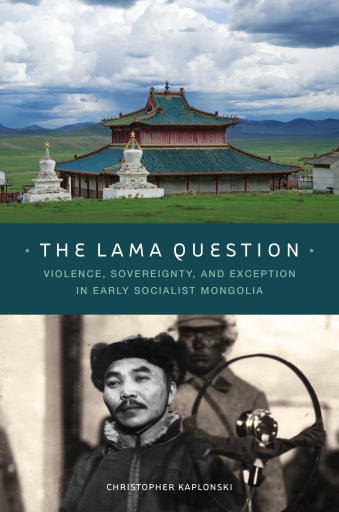
The Lama Question
Published by University of Hawaii Press
English
282 pages
2014
ISBN 9780824838577
Estimated reading time: 5 h 10 min
PDF
Buy at Ebooks Agustin
🇪🇸
 Association of University Presses - Tienda FILUNI
🇺🇸
Visit store →
Association of University Presses - Tienda FILUNI
🇺🇸
Visit store →
 Bajalibros Argentina
🇦🇷
Visit store →
Bajalibros Argentina
🇦🇷
Visit store →
 Bajalibros Latam
🇺🇸
Visit store →
Bajalibros Latam
🇺🇸
Visit store →
 Bookshop Uruguay
🇺🇾
Visit store →
Bookshop Uruguay
🇺🇾
Visit store →
 Catademic
🇺🇸
Visit store →
Catademic
🇺🇸
Visit store →
Available at 13 bookshops
Association of University Presses - Tienda FILUNI
🇺🇸
Visit store →
Bajalibros Argentina
🇦🇷
Visit store →
Bajalibros Latam
🇺🇸
Visit store →
Bookshop Uruguay
🇺🇾
Visit store →
Catademic
🇺🇸
Visit store →








About this book
Before becoming the second socialist country in the world (after the Soviet Union) in 1921, Mongolia had been a Buddhist feudal theocracy. Combatting the influence of the dominant Buddhist establishment to win the hearts and minds of the Mongolian people was one of the most important challenges faced by the new socialist government. It would take almost a decade and a half to resolve the “lama question,” and it would be answered with brutality, destruction, and mass killings. Chris Kaplonski examines this critical, violent time in the development of Mongolia as a nation-state and its ongoing struggle for independence and recognition in the twentieth century.
Unlike most studies that explore violence as the primary means by which states deal with their opponents, The Lama Question argues that the decision to resort to violence in Mongolia was not a quick one; neither was it a long-term strategy nor an out-of control escalation of orders but the outcome of a complex series of events and attempts by the government to be viewed as legitimate by the population. Kaplonski draws on a decade of research and archival resources to investigate the problematic relationships between religion and politics and geopolitics and biopolitics in early socialist Mongolia, as well as the multitude of state actions that preceded state brutality. By examining the incidents and transformations that resulted in violence and by viewing violence as a process rather than an event, his work not only challenges existing theories of political violence, but also offers another approach to the anthropology of the state. In particular, it presents an alternative model to philosopher Georgio Agamben’s theory of sovereignty and the state of exception.
The Lama Question will be of interest to scholars and students of violence, the state, biopolitics, Buddhism, and socialism, as well as to those interested in the history of Mongolia and Asia in general.
Availability
The Lama Question is available as PDF at 13 online bookshops. Bookshops carrying it include Association of University Presses - Tienda FILUNI, Bajalibros Argentina, Bajalibros Latam.
- Language
- English
Share
Frequently asked questions
- In what formats is The Lama Question available?
- The Lama Question is available as PDF at 13 online bookshops.
- Where can I buy The Lama Question?
- You can buy The Lama Question at Association of University Presses - Tienda FILUNI, Bajalibros Argentina, Bajalibros Latam. Compare every option in the list on this page.
- How long does it take to read The Lama Question?
- At an average reading pace, The Lama Question takes about 5 h 10 min to read (282 pages).
Ratings & reviews
No ratings yet. Be the first to review this book.
Sign in to rate and review this book.