The Significance of Archaeological Textiles

The Significance of Archaeological Textiles

Published by Dr Ludwig Reichert Verlag

English 209 pages 2024
Estimated reading time: 3 h 50 min
PDF

About this book

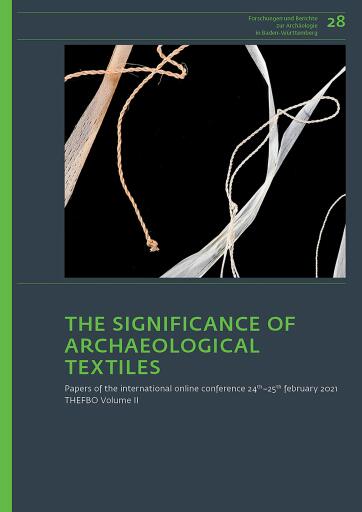
The everyday utensils of prehistoric agricultural settlements were, to a large extent, textile products. Functional textiles were used in everyday subsistence and helped the settlements' inhabitants carry out tasks that were indispensable in the context of a sedentary lifestyle. In this context, the question arises as to what extent sedentariness would have been possible without textiles, simply because there is no other material that is as versatile as textile raw material. This particular topic was part of the joint project "THEFBO: Textile craftsmanship in the prehistoric wetland settlements on Lake Constance and Upper Swabia – requirements for textiles and their perception". The project was funded by the German Federal Ministry of Education and Research from 2019 to 2021 and coordinated by the Landesamt für Denkmalpflege im Regierungspräsidium Stuttgart. Results of the project will be presented in THEFBO volume I / Forschungen und Berichte zur Archäologie in Baden-Württemberg 27. Part of this project was an online conference from 24th–26th February 2021, the proceedings of which are presented in THEFBO volume II. It dealt with textile findings and raw materials from a dendrological, paleobotanical, textile-archaeological and cultural-historical perspective.The broad spectrum of topics gave insights into the wide range of technical textiles in prehistory. Some of the oldest and most outstanding textile finds such as early Holocene tree bast strings, ropes, and nets from Friesack 4 in Brandenburg or the strings and bags from the wells of the Early Neolithic Linear Pottery Culture were presented and discussed at the conference. Other case studies considered Neolithic basketry and cordage in the Iberian Peninsula, Neolithic and Bronze Age textiles and tools from Northern Italy, textile tools and imprints on clay sealings from Bronze Age Greece to prehistoric objects made of plant fibres and wool from ice patches in the Bernese Alps, Switzerland. Contributions discussing the distribution of Lime trees (Tilia spec.) in prehistoric European landscapes, experimental approaches to manufacturing prehistoric threads or aspects of textile terminology completed the conference.

Availability

The Significance of Archaeological Textiles is available as PDF at 8 online bookshops. Bookshops carrying it include Bajalibros Argentina, Bajalibros Latam, Bookshop Uruguay.

Language
English
Share

Frequently asked questions

In what formats is The Significance of Archaeological Textiles available?
The Significance of Archaeological Textiles is available as PDF at 8 online bookshops.
Where can I buy The Significance of Archaeological Textiles?
You can buy The Significance of Archaeological Textiles at Bajalibros Argentina, Bajalibros Latam, Bookshop Uruguay. Compare every option in the list on this page.
How long does it take to read The Significance of Archaeological Textiles?
At an average reading pace, The Significance of Archaeological Textiles takes about 3 h 50 min to read (209 pages).

Ratings & reviews

No ratings yet. Be the first to review this book.

Sign in to rate and review this book.

Comments

Sign in to join the conversation.

No comments yet.