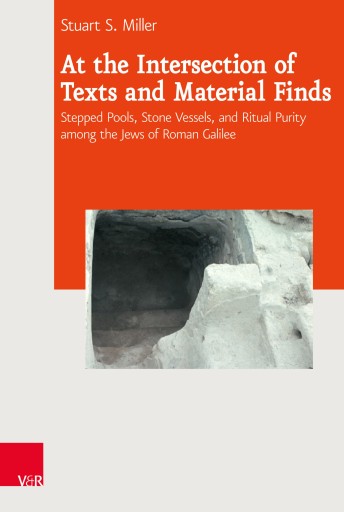
At the Intersection of Texts and Material Finds
Publié par Vandenhoeck & Ruprecht
English
424 pages
2019
ISBN 9783647564784
Temps de lecture estimé : 7 h 46 min
PDF
Buy at Sanborns Ebooks
🇲🇽
 Alpha Books
🇨🇴
Visiter la boutique →
Alpha Books
🇨🇴
Visiter la boutique →
 Bajalibros Argentina
🇦🇷
Visiter la boutique →
Bajalibros Argentina
🇦🇷
Visiter la boutique →
 Bajalibros Latam
🇺🇸
Visiter la boutique →
Bajalibros Latam
🇺🇸
Visiter la boutique →
 Bookshop Uruguay
🇺🇾
Visiter la boutique →
Bookshop Uruguay
🇺🇾
Visiter la boutique →
 Crisol Ebooks
🇵🇪
Visiter la boutique →
Crisol Ebooks
🇵🇪
Visiter la boutique →
Disponible dans 15 librairies
Alpha Books
🇨🇴
Visiter la boutique →
Bajalibros Argentina
🇦🇷
Visiter la boutique →
Bajalibros Latam
🇺🇸
Visiter la boutique →
Bookshop Uruguay
🇺🇾
Visiter la boutique →
Crisol Ebooks
🇵🇪
Visiter la boutique →










À propos de ce livre
Stuart Miller examines the hermeneutical challenges posed by the material and literary evidence pertaining to ritual purity practices in Graeco-Roman Palestine and, especially, the Galilee. He contends that "stepped pools," which we now know were in use well beyond the Destruction of the Temple, and, as indicated by the large collection on the western acropolis of Sepphoris and elsewhere, into the Middle and Late Roman/Byzantine eras,must be understood in light of biblical and popular perspectives on ritual purity. The interpretation of the finds is too frequently forced to conform to rabbinic prescriptions, which oftentimes were the result of the sages' unique and creative, nominalist approach to ritual purity. Special attention is given to the role ritual purity continued to play in the lives of ordinary Jews despite (or because of) the loss of the Temple. Miller argues against the prevailing tendency to type material finds—and Jewish society––according to known groups (pre-70 C.E.: Pharisaic, Sadducaic, Essenic; post 70 C.E.: rabbinic, priestly, etc.). He further counters the perception that ritual purity practices were largely the interest of priests and argues against the recent suggestion that the kohanim resurfaced as an influential group in Late Antiquity. Building upon his earlier work on "sages and commoners," Miller claims that the rabbis emerged out of a context in which a biblically derived "complex common Judaism" thrived. Stepped pools, stone vessels, and other material finds are realia belonging to this "complex common Judaism." A careful reading of the rabbis indicates that they were acutely aware of the extent to which ritual purity rites pertaining to home and family life had "spread," which undoubtedly contributed to their intense interest in regulating them.
Disponibilité
At the Intersection of Texts and Material Finds est disponible en PDF dans 15 librairies en ligne. Parmi les librairies qui le proposent : Alpha Books, Bajalibros Argentina, Bajalibros Latam.
Catégories
- Langue
- English
Partager
Questions fréquentes
- Dans quels formats At the Intersection of Texts and Material Finds est-il disponible ?
- At the Intersection of Texts and Material Finds est disponible en PDF dans 15 librairies en ligne.
- Où puis-je acheter At the Intersection of Texts and Material Finds ?
- Vous pouvez acheter At the Intersection of Texts and Material Finds sur Alpha Books, Bajalibros Argentina, Bajalibros Latam. Comparez toutes les options dans la liste de cette page.
- Combien de temps faut-il pour lire At the Intersection of Texts and Material Finds ?
- À un rythme de lecture moyen, At the Intersection of Texts and Material Finds se lit en environ 7 h 46 min (424 pages).
Notes et avis
Pas encore de note. Soyez le premier à donner votre avis sur ce livre.
Se connecter pour noter ce livre et donner votre avis.