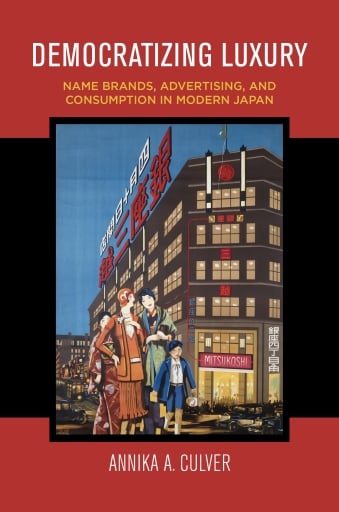
Democratizing Luxury
Publié par University of Hawaii Press
English
417 pages
2023
ISBN 9780824896706
Temps de lecture estimé : 7 h 39 min
PDF
Buy at Viubux
🇲🇽
 Association of University Presses - Tienda FILUNI
🇺🇸
Visiter la boutique →
Association of University Presses - Tienda FILUNI
🇺🇸
Visiter la boutique →
 Bajalibros Argentina
🇦🇷
Visiter la boutique →
Bajalibros Argentina
🇦🇷
Visiter la boutique →
 Bajalibros Latam
🇺🇸
Visiter la boutique →
Bajalibros Latam
🇺🇸
Visiter la boutique →
 Bookshop Uruguay
🇺🇾
Visiter la boutique →
Bookshop Uruguay
🇺🇾
Visiter la boutique →
 Catademic
🇺🇸
Visiter la boutique →
Catademic
🇺🇸
Visiter la boutique →
Disponible dans 13 librairies
Association of University Presses - Tienda FILUNI
🇺🇸
Visiter la boutique →
Bajalibros Argentina
🇦🇷
Visiter la boutique →
Bajalibros Latam
🇺🇸
Visiter la boutique →
Bookshop Uruguay
🇺🇾
Visiter la boutique →
Catademic
🇺🇸
Visiter la boutique →








À propos de ce livre
Democratizing Luxury explores the interplay between advertising and consumption in modern Japan by investigating how Japanese companies at key historical moments assigned value, or "luxury," to mass-produced products as an important business model. Japanese name-brand luxury evolved alongside a consumer society emerging in the late nineteenth century, with iconic companies whose names became associated with quality and style. At the same time, Western ideas of modernity merged with earlier artisanal ideals to create Japanese connotations of luxury for readily accessible products. Businesses manufactured items at all price points to increase consumer attainability, while starkly curtailing production for limited editions to augment desirability.
Between the late nineteenth and twenty-first centuries, control over family disposable income transformed Japanese middle-class women into an important market. Growth of purchasing power among women corresponded with Japanese goods diffusing throughout the empire, and globally after the Asia-Pacific war (1931–1945). This book offers case studies that examine affordable luxury consumer items often advertised to women, including drinks, beauty products, fashion, and timepieces. Japanese companies have capitalized on affordable luxury since a flourishing domestic mercantile economy began in the Tokugawa period (1603–1868), showcasing brand-name shops, renowned artisans, and mass-produced woodblock prints by famous artists. In the late nineteenth century, personalized service expanded within department stores like Mitsukoshi, Shiseidō cosmetic counters, and designer boutiques. Shiseidō now globally markets invented traditions of omotenashi, Japanese ”values” of hospitality expressed in purchasing and consuming its products.
In postwar times, when a thriving democracy and middle-class were tied to greater disposable income and consumerism, companies rebuilt a growing consumer base among cautious shoppers: democratizing luxury at reasonable prices and maintaining business patterns of accessibility, high quality, and exemplary service. Nationalism amid economic success soon blended with myths of unique Japanese identity in a mass consumer society, suffused by commodity fetishism with widely available brand names. As the first comprehensive history of iconic Japanese name brands and their unique connotations of luxury and accessibility in modern Japan and elsewhere, Democratizing Luxury explores company histories and reveals strategies that lead customers to consume these alluring commodities.
Disponibilité
Democratizing Luxury est disponible en PDF dans 13 librairies en ligne. Parmi les librairies qui le proposent : Association of University Presses - Tienda FILUNI, Bajalibros Argentina, Bajalibros Latam.
Catégories
- Langue
- English
Partager
Questions fréquentes
- Dans quels formats Democratizing Luxury est-il disponible ?
- Democratizing Luxury est disponible en PDF dans 13 librairies en ligne.
- Où puis-je acheter Democratizing Luxury ?
- Vous pouvez acheter Democratizing Luxury sur Association of University Presses - Tienda FILUNI, Bajalibros Argentina, Bajalibros Latam. Comparez toutes les options dans la liste de cette page.
- Combien de temps faut-il pour lire Democratizing Luxury ?
- À un rythme de lecture moyen, Democratizing Luxury se lit en environ 7 h 39 min (417 pages).
Notes et avis
Pas encore de note. Soyez le premier à donner votre avis sur ce livre.
Se connecter pour noter ce livre et donner votre avis.