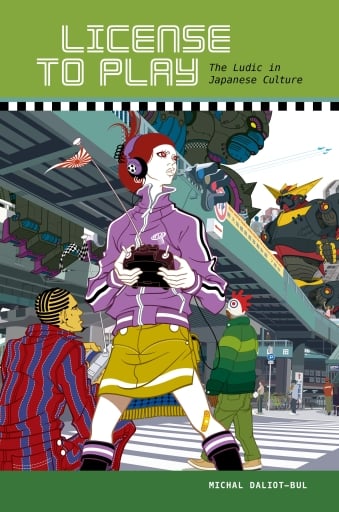
License to Play
Publié par University of Hawaii Press
English
2014
ISBN 9780824853198
eBook
Buy at Association of University Presses - Tienda FILUNI
🇺🇸
 Bajalibros Argentina
🇦🇷
Visiter la boutique →
Bajalibros Argentina
🇦🇷
Visiter la boutique →
 Bajalibros Latam
🇺🇸
Visiter la boutique →
Bajalibros Latam
🇺🇸
Visiter la boutique →
 Bookshop Uruguay
🇺🇾
Visiter la boutique →
Bookshop Uruguay
🇺🇾
Visiter la boutique →
 Catademic
🇺🇸
Visiter la boutique →
Catademic
🇺🇸
Visiter la boutique →
Disponible dans 13 librairies
 Bajalibros Argentina
🇦🇷
Visiter la boutique →
Bajalibros Latam
🇺🇸
Visiter la boutique →
Bookshop Uruguay
🇺🇾
Visiter la boutique →
Catademic
🇺🇸
Visiter la boutique →
Bajalibros Argentina
🇦🇷
Visiter la boutique →
Bajalibros Latam
🇺🇸
Visiter la boutique →
Bookshop Uruguay
🇺🇾
Visiter la boutique →
Catademic
🇺🇸
Visiter la boutique →








À propos de ce livre
Play is one of the most powerful cultural forces in contemporary Japan and in other late modern societies. In this notable contribution to our understanding of play, Michal Daliot-Bul explores the intricate and dynamic transformations of culture and play (asobi) in Japan. Along the way, she takes readers on a theoretically informed journey to better comprehend what makes play a significant cultural function, asking such questions as “How can we explain the dialectics between play as a biological instinct and play as a culturally specific activity? What defines the best player? How is creativity related to play? What is the difference between play and playfulness? Are some cultures more play-oriented than others, and if so, why?” Daliot-Bul argues that the cultural meaning of play and its influence on sociocultural life are not inherent properties of a fixed, universal behavior called play but rather are conditioned by changing cultural contexts and competing social ideologies.
Spanning Japan’s premodern period to the twenty-first century, the extent and expressions of play described in this book become thought-provoking lenses through which to view Japanese social dynamics and cultural complexities. As she approaches the post-industrialized 1970s in Japan, Daliot-Bul’s narrative also explores urban consumer culture as a system for organizing daily life, the tension between institutional and contemporary popular cultures, the production of new gender identities, and the cultural construction of urban space.
License to Play is an insightful and engaging work that will appeal widely to scholars and students specializing in cultural studies, cultural anthropology, and Japanese studies. Given the global fascination with Japanese popular culture and with play-like pleasures in late consumer cultures, the book will also find a readership among those interested in Japan in general and the universal phenomenon of play.
Disponibilité
License to Play est disponible en eBook dans 13 librairies en ligne. Parmi les librairies qui le proposent : Association of University Presses - Tienda FILUNI, Bajalibros Argentina, Bajalibros Latam.
Catégories
- Langue
- English
Partager
Questions fréquentes
- Dans quels formats License to Play est-il disponible ?
- License to Play est disponible en eBook dans 13 librairies en ligne.
- Où puis-je acheter License to Play ?
- Vous pouvez acheter License to Play sur Association of University Presses - Tienda FILUNI, Bajalibros Argentina, Bajalibros Latam. Comparez toutes les options dans la liste de cette page.
Notes et avis
Pas encore de note. Soyez le premier à donner votre avis sur ce livre.
Se connecter pour noter ce livre et donner votre avis.