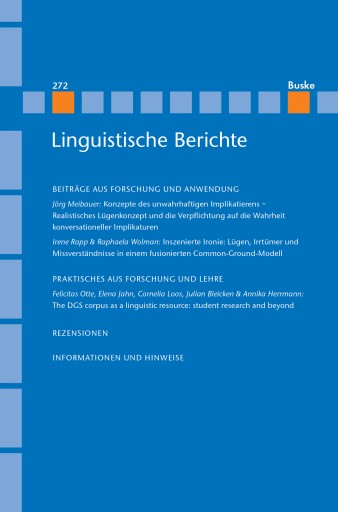
Linguistische Berichte Heft 272
Publié par Helmut Buske Verlag
Disponible dans 1 librairies

À propos de ce livre
Disponibilité
Linguistische Berichte Heft 272 est disponible en PDF dans 1 librairie en ligne.
Catégories
- Langue
- German
Questions fréquentes
- Dans quels formats Linguistische Berichte Heft 272 est-il disponible ?
- Linguistische Berichte Heft 272 est disponible en PDF dans 1 librairie en ligne.
- Où puis-je acheter Linguistische Berichte Heft 272 ?
- Vous pouvez acheter Linguistische Berichte Heft 272 sur Sanborns Ebooks. Comparez toutes les options dans la liste de cette page.
- Combien de temps faut-il pour lire Linguistische Berichte Heft 272 ?
- À un rythme de lecture moyen, Linguistische Berichte Heft 272 se lit en environ 2 h 15 min (123 pages).
Notes et avis
Pas encore de note. Soyez le premier à donner votre avis sur ce livre.
Se connecter pour noter ce livre et donner votre avis.
Vous aimerez aussi

Linguistische Berichte Heft 279

Jorge Semprún
Das Phantastische in der deutschsprachigen Literatur
180 Masterpieces of World Literature (Vol.1)
Verne, Jules, Carroll, Lewis, Freud, Sigmund, Dickens, Charles, Plato, Twain, Mark, Whitman, Walt, Wilde, Oscar, Poe, Edgar Allan, Shakespeare, William, Brontë, Charlotte, Brontë, Anne, Brontë, Emily, Thoreau, Henry David, James, Henry, Alcott, Louisa May, Hugo, Victor, Burnett, Frances Hodgson, Austen, Jane, Melville, Herman, Allen, James, Eliot, George, Scott, Walter, Hardy, Thomas, Defoe, Daniel, Christie, Agatha, Sinclair, Upton, Trollope, Anthony, Proust, Marcel, Baudelaire, Charles, Thackeray, William Makepeace, Dreiser, Theodore, Voltaire, Douglass, Frederick, Keats, John, Joyce, James, Gibran, Kahlil, Wells, H. G., Eliot, T. S., Lawrence, D. H., Forster, E. M., Aurelius, Marcus, Andersen, Hans Christian, Chekhov, Anton, Tolstoy, Leo, Dostoevsky, Fyodor, Gógol, Nikolai, de Cervantes, Miguel, Wattles, Wallace D., Grimm, Brothers, Hesse, Herman, Tzu, Sun

Harvard's Classics Collection: Complete 71 Volumes
Goethe, Johann Wolfgang von, Lessing, Gotthold Ephraim, Bjørnson, Bjørnstjerne, Carlyle, Thomas, Storm, Theodor, Plato, Fontane, Theodor, Descartes, René, Keller, Gottfried, Twain, Mark, Kant, Immanuel, Darwin, Charles, Luther, Martin, Stevenson, Robert Louis, Shakespeare, William, Dante Alighieri, Eurípides, Shelley, Percy Bysshe, Lamb, Charles, Thoreau, Henry David, James, Henry, Johnson, Samuel, Mill, John Stuart, Hugo, Victor, Hume, David, Addison, Joseph, Austen, Jane, Locke, John, Fletcher, John, Beaumont, Francis, Hunt, Leigh, Epictetus, Daudet, Alphonse, De Quincey, Thomas, Maupassant, Guy de, Eliot, George, Scott, Walter, Sterne, Laurence, Coleridge, Samuel Taylor, Swift, Jonathan, Marlowe, Christopher, Grimm, Wilhelm, Hazlitt, William, Cicero, Marcus Tullius, Defoe, Daniel, Aesop, Dana, Richard Henry, Fielding, Henry, Dryden, John, Massinger, Philip, de la Barca, Pedro Calderón, Harte, Bret, Sand, George, Ruskin, John, Holmes, Oliver Wendell, Renan, Ernest, Burns, Robert, Garrick, David, Emerson, Ralph Waldo, Webster, John, Irving, Washington, Walton, Izaak, Bunyan, John, Valera, Juan, de Musset, Alfred, Lowell, James Russell, Sainte-Beuve, Charles Augustin, Hawthorne, Nathaniel, Homer, Burke, Edmund, Plutarch, Molière, Aeschylus, Faraday, Michael, Sophocles, Thackeray, William Makepeace, Franklin, Benjamin, Hale, Edward Everett, Corneille, Pierre, Racine, Jean, Voltaire, Browning, Robert, Goldsmith, Oliver, Dekker, Thomas, Milton, John, Aristophanes, Pascal, Blaise, Virgil, Sheridan, Richard Brinsley, Newcomb, Simon, Penn, William, Bigges, Walter, Sidney, Philip, Herodotus, Raleigh, Walter, Bacon, Francis, Mazzini, Giuseppe, Pretty, Francis, Berkeley, George, Hobbes, Thomas, Smith, Adam, Manzoni, Alessandro, Cowley, Abraham, Montaigne, Michel de, Jonson, Ben, Woolman, John, Cellini, Benvenuto, Smith, Sydney, Froissart, Jean, Harrison, William Henry, Harvey, William, Aurelius, Marcus, Andersen, Hans Christian, Malory, Thomas, Byron, George Gordon, Kempis, Thomas à, Turgenev, Ivan, Steele, Richard, Browne, Thomas, Geikie, Archibald, Macaulay, Thomas Babington, Tolstoy, Leo, Dostoevsky, Fyodor, Tacitus, Roper, William, Hippocrates, de Cervantes, Miguel, More, Thomas, von Schiller, Friedrich, Nichols, Philip, Pasteur, Louis, Lister, Joseph, Rousseau, Jean-Jacques, Younger, Pliny the, Eliot, Charles W., Poe, Edgar Alan, Augustine, Saint, von Helmholtz, Hermann Ludwig Ferdinand, Drake, Francis, Haies, Edward, Machiavelli, Niccolò, Paré, Ambroise, Neilson, William A., Balzac, Honoré, Kielland, Alexander L.