Aller au contenu principal
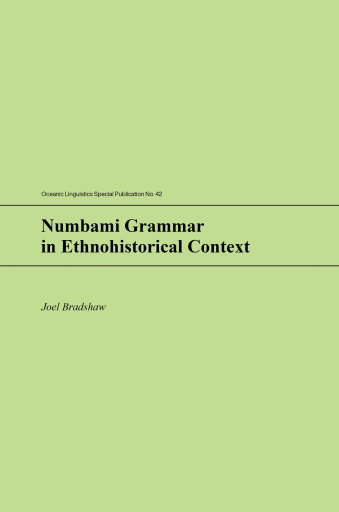
Numbami Grammar in Ethnohistorical Context

Numbami Grammar in Ethnohistorical Context

Par Bradshaw, Joel

Publié par University of Hawaii Press

English 149 pages 2025 ISBN 9798880702213
Temps de lecture estimé : 2 h 44 min
PDF

À propos de ce livre

The Numbami language is a small isolate, tied to only one coastal village, within the Huon Gulf family of Austronesian languages in Papua New Guinea. It is currently classified as threatened, with roughly two hundred active speakers according to its latest Ethnologue listing. Numbami Grammar in Ethnohistorical Context is the first comprehensive description of the language and its ethnolinguistic relations to neighboring languages, both Austronesian and Papuan. Language contact has had significant effects on all the Oceanic languages of New Guinea. This description therefore offers more ethnohistorical coverage than most reference grammars do, documenting such factors as oral history sources, evidence of multilingual villages in past and present, and frequent movement and prolonged contact among the coastal languages. It also notes the recent strong influence of Jabêm, the German Lutheran mission lingua franca; Tok Pisin, the national lingua franca; and English. Linguistic coverage focuses especially on verbs: subject/mood marking; verb serialization; deverbal resultatives, prepositions, and complementizers; and the highly productive compositional semantics of two small sets of ubiquitous “core verbs.” The members of one set function as polysemous light verbs, while the members of the other set play complementary roles in multiverb path constructions. Numbami serial verb constructions (SVCs) include switch-subject as well as same-subject relationships between verbs. The subjects of some adverbial serial verbs appear to be the events described by the earlier verbs in the SVC. Although Numbami appears to be phonologically conservative, it has shed most of its inherited Oceanic morphology. Possessive suffixes exist only on a few kinship terms, there is only one set of genitive pronouns, and there are no morphological means of deriving verbs from nouns or nouns from verbs. Light verbs and resultatives work to expand the inventory of verbal expressions, and postposed attributive genitives help expand the inventory of nominal expressions. Relative clauses are postposed and marked at both ends, as in most of the neighboring Oceanic languages. One chapter notes discourse phenomena, including topic marking, tail-head linkage, and a tabular analysis of the roles of overt vs. null subjects in narrative texts. Those texts are reproduced with interlinear glosses and translations in the appendices.

Disponibilité

Numbami Grammar in Ethnohistorical Context est disponible en PDF dans 13 librairies en ligne. Parmi les librairies qui le proposent : Association of University Presses - Tienda FILUNI, Bajalibros Argentina, Bajalibros Latam.

Langue
English
Partager

Questions fréquentes

Dans quels formats Numbami Grammar in Ethnohistorical Context est-il disponible ?
Numbami Grammar in Ethnohistorical Context est disponible en PDF dans 13 librairies en ligne.
Où puis-je acheter Numbami Grammar in Ethnohistorical Context ?
Vous pouvez acheter Numbami Grammar in Ethnohistorical Context sur Association of University Presses - Tienda FILUNI, Bajalibros Argentina, Bajalibros Latam. Comparez toutes les options dans la liste de cette page.
Combien de temps faut-il pour lire Numbami Grammar in Ethnohistorical Context ?
À un rythme de lecture moyen, Numbami Grammar in Ethnohistorical Context se lit en environ 2 h 44 min (149 pages).

Notes et avis

Pas encore de note. Soyez le premier à donner votre avis sur ce livre.

Se connecter pour noter ce livre et donner votre avis.
Commentaires

Se connecter pour rejoindre la conversation.

Pas encore de commentaires.