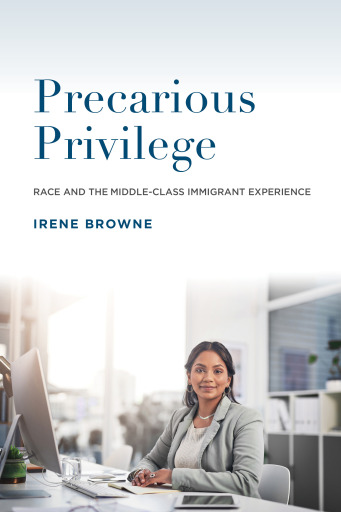
Precarious Privilege
Par Browne, Irene
Publié par Russell Sage Foundation
English
2024
ISBN 9781610449250
eBook
Buy at Catademic
🇺🇸
Catademic
🇺🇸
Visiter la boutique →
Bajalibros Latam
🇺🇸
Visiter la boutique →
Association of University Presses - Tienda FILUNI
🇺🇸
Visiter la boutique →
Ebooks Librería Antártica
🇨🇱
Visiter la boutique →
Ebooks Agustin
🇪🇸
Visiter la boutique →
Bajalibros Argentina
🇦🇷
Visiter la boutique →

Sanborns Ebooks
🇲🇽
Visiter la boutique →
ebooks Libreria del GAM
🇨🇱
Visiter la boutique →
Bookshop Uruguay
🇺🇾
Visiter la boutique →

ebookskitapenas
🇬🇹
Visiter la boutique →
Ebooks Yenny - El Ateneo
🇦🇷
Visiter la boutique →
Crisol Ebooks
🇵🇪
Visiter la boutique →
Disponible dans 12 librairies
Catademic
🇺🇸
Visiter la boutique →

Association of University Presses - Tienda FILUNI
🇺🇸
Visiter la boutique →
Ebooks Librería Antártica
🇨🇱
Visiter la boutique →
Ebooks Agustin
🇪🇸
Visiter la boutique →
Sanborns Ebooks
🇲🇽
Visiter la boutique →
ebooks Libreria del GAM
🇨🇱
Visiter la boutique →
ebookskitapenas
🇬🇹
Visiter la boutique →
Ebooks Yenny - El Ateneo
🇦🇷
Visiter la boutique →
Crisol Ebooks
🇵🇪
Visiter la boutique →
À propos de ce livre
In recent years crackdowns on immigrant labor and a shrinking job market in California, Arizona, and Texas have pushed Latine immigrants to new destinations, particularly places in the American South. Although many of these immigrants work in manufacturing or food-processing plants, a growing number belong to the professional middle class. These professionals find that despite their privileged social class and regardless of their national origin, many non-Latines assume that they are undocumented working-class Mexicans, the stereotype of the “typical Latine.” In <i>Precarious Privilege</i>, sociologist Irene Browne focuses on how first-generation middle-class Mexican and Dominican immigrants in Atlanta respond to this stigmatizing assumption.<br> <br> Browne finds that when asked to identify themselves by race, these immigrants either reject racial identities entirely or draw on belief systems from Mexico and the Dominican Republic that emphasize European-indigenous mixed race identities. When branded as typical Latines in the U.S., Mexican middle-class immigrants emphasize their social class or explain that a typical Latine can be middle-class, while Dominicans simply indicate that they are not Mexican. Rather than blame systemic racism, both Mexican and Dominican middle-class immigrants often attribute misperceptions of their identity to non-Latines’ ignorance or to individual Latines’ lack of effort in trying to assimilate.<br> <br> But these middle-class Latine immigrants do not simply seek to position themselves on par with the U.S.-born white middle class. Instead, they leverage their cosmopolitanism—for example, their multilingualism or their children’s experiences traveling abroad—to engage in what Browne calls “one-up assimilation,” a strategy that aims to position them above the white middle class, who are often monolingual and unaware of the world outside the United States. Middle-class Latines’ cosmopolitanism and valuing of diversity also lead them to have cordial relations with African Americans, but these immigrants do not see themselves as sharing African Americans’ status as oppressed minorities.<br> <br> Although the stereotype of the typical Latine has made middle-class Latine immigrants susceptible to stigma, they insist that this stigma does not play a significant role in their lives. In many cases, they view the stereotype as a minor issue, feel that opportunities for upward mobility outweigh any negative experiences, or downplay racism by emphasizing their class privilege. Browne observes that while downplaying racism may help middle-class Latine immigrants maintain their dignity, it also perpetuates inequality by reinforcing the lower status of working-class undocumented immigrants. It is thus imperative, Browne argues, to repeal harsh anti-immigration policies, a move that will not only ease the lives of the undocumented but also send a message about who belongs in the country.<br> Offering a nuanced exploration of how race, social class, and immigration status intersect, <i>Precarious Privilege</i> provides a complex portrait of middle-class Latine immigrants in the United States today.<br>
Catégories
- Langue
- English
Partager
Vous aimerez aussi
Chile: los dilemas de una crisis
Luis A. Riveros Cornejo
Direito e aspectos econômicos na sociedade da informação
Pellin, Daniela
As Malhas do Poder: A Reconfiguração da Noção de Poder na Filosofia de Michel Foucault
Barros, Igor Corrêa de
Nuestro desafío ambiental
Wild Botero, Nicolás
¿Cómo comprender lo social para colaborar en su cambio?
Quintana, Roberto Diego
Economía política del conocimiento en el sur global
Vásquez, Jorge Daniel, Cielo, Cristina, Bravo, Pedro Andrés