
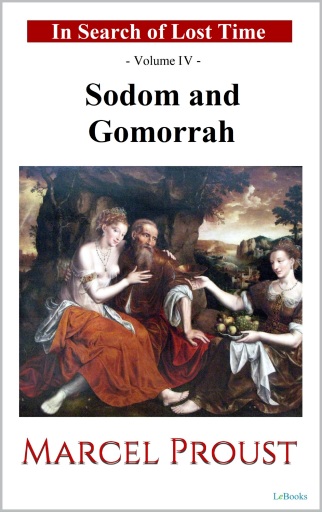
Sodom and Gomorrah
Par Proust, Marcel
Publié par Lebooks Editora
Disponible dans 11 librairies
 Disal - Distribuidora de Conhecimento
🇧🇷
Visiter la boutique →
Disal - Distribuidora de Conhecimento
🇧🇷
Visiter la boutique →










Vendu directement par l'éditeur indépendant Disal - Distribuidora de Conhecimento
À propos de ce livre
Disponibilité
Sodom and Gomorrah est disponible en eBook dans 11 librairies en ligne. Parmi les librairies qui le proposent : Disal - Distribuidora de Conhecimento, Martins Fontes Paulista, Bajalibros Argentina. Achetez-le directement auprès de son éditeur sur Disal - Distribuidora de Conhecimento, Martins Fontes Paulista.
Catégories
- Langue
- English
Questions fréquentes
- Dans quels formats Sodom and Gomorrah est-il disponible ?
- Sodom and Gomorrah est disponible en eBook dans 11 librairies en ligne.
- Où puis-je acheter Sodom and Gomorrah ?
- Vous pouvez acheter Sodom and Gomorrah sur Disal - Distribuidora de Conhecimento, Martins Fontes Paulista, Bajalibros Argentina. Comparez toutes les options dans la liste de cette page.
Notes et avis
Pas encore de note. Soyez le premier à donner votre avis sur ce livre.
Se connecter pour noter ce livre et donner votre avis.
Vous aimerez aussi

Historia de dos ciudades
Charles Dickens
A história de Pat de Silver Bush
Montgomery, Lucy Maud

El mito de Sísifo
Camus, Albert
The Greatest Literary Classics Of All Time
James, Henry, Poe, Edgar Allan, Lovecraft, H. P., Wallace, Lewis, Shakespeare, William, Milton, John, Swift, Jonathan, Defoe, Daniel, Fielding, Henry, Sterne, Laurence, Austen, Jane, Thackeray, William Makepeace, Shelley, P. B., Shelley, Mary, Keats, John, Brontë, Charlotte, Brontë, Emily, Brontë, Anne, Eliot, George, Dickens, Charles, Hardy, Thomas, Von Arnim, Elizabeth, Lawrence, D. H., Radcliffe, Ann Ward, Stoker, Bram, Doyle, Arthur Conan, Conrad, Joseph, Wilde, Oscar, Carroll, Lewis, Burnett, Frances Hodgson, Lewis, C. S., Grossmith, George Weedon, Wells, H. G., Collins, Willkie, Chesterton, G. K., Forster, E. M., Eliot, T. S., Joyce, James, Shaw, George Bernard, Yeats, W. B., Scott, Sir Walter, Stevenson, Robert Louis, Grahame, Kenneth, MacDonald, George, Barrie, J. M., Twain, Mark, London, Jack, Melville, Herman, Hawthorne, Nathaniel, Alcott, Louisa May, Cather, Willa, Wharton, Edith, Chopin, Kate, Thoreau, Henry David, Whitman, Walt, Gibran, Kahlil, Stowe, Harriet Beecher, Douglass, Frederick, Cooper, James Fenimore, Montgomery, L. M., Homer, Plato, Apuleius, Aurelius, Marcus, von Goethe, Johann Wolfgang, Hesse, Herman, Nietzsche, Friedrich, Verne, Jules, Proust, Marcel, Hugo, Victor, Flaubert, Gustave, Leroux, Gastón, de Balzac, Honoré, Stendhal, Voltaire, Baudelaire, Charles, Dumas, Alexandre, Zola, Émile, Ibsen, Henrik, Tolstoy, Leo, Dostoyevsky, Fyodor, Turgenev, Ivan, Chekhov, Anton, Gógol, Nikolai, de Cervantes, Miguel, Galdós, Benito Pérez, de la Barca, Pedro Calderón, Dante, Boccaccio, Giovanni, Machiavelli, Niccolò, Tagore, Rabindranath, Chatterjee, Bankim Chandra, Kâlidasa, Válmíki, Laozi, Tzu, Sun, Confucius, Xueqin, Cao, Der Ling, Princess, Nitobe, Inazo, Okakura, Kakuzo, Natsume, Sōseki, Gilman, Charlotte Perkins, Fitzgerald, F. Scott, Howells, William Dean, Irving, Washington, Baum, L. Frank, Storm, Theodor, Valera, Juan, Kipling, Rudyard
Jean Santeuil
Proust, Marcel