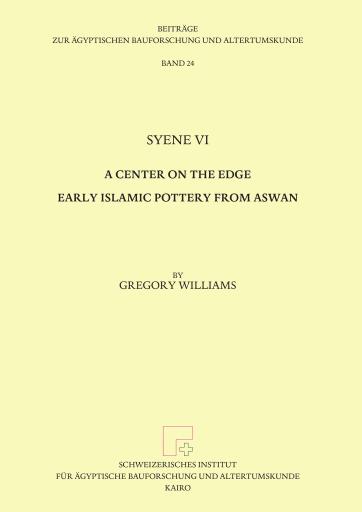
Syene VI
Publié par PeWe-Verlag
English
201 pages
2022
ISBN 9783689850111
Temps de lecture estimé : 3 h 41 min
PDF
Buy at Sanborns Ebooks
🇲🇽
 Alpha Books
🇨🇴
Visiter la boutique →
Alpha Books
🇨🇴
Visiter la boutique →
 Bajalibros Argentina
🇦🇷
Visiter la boutique →
Bajalibros Argentina
🇦🇷
Visiter la boutique →
 Bajalibros Latam
🇺🇸
Visiter la boutique →
Bajalibros Latam
🇺🇸
Visiter la boutique →
 Bookshop Uruguay
🇺🇾
Visiter la boutique →
Bookshop Uruguay
🇺🇾
Visiter la boutique →
 Crisol Ebooks
🇵🇪
Visiter la boutique →
Crisol Ebooks
🇵🇪
Visiter la boutique →
Disponible dans 13 librairies
Alpha Books
🇨🇴
Visiter la boutique →
Bajalibros Argentina
🇦🇷
Visiter la boutique →
Bajalibros Latam
🇺🇸
Visiter la boutique →
Bookshop Uruguay
🇺🇾
Visiter la boutique →
Crisol Ebooks
🇵🇪
Visiter la boutique →








À propos de ce livre
In the 9th century CE, the city of Aswan, Egypt was a prosperous provincial capital on the pilgrimage route to Mecca and Medina via the Red Sea, as well as trade routes connecting the Nile River to the Wadi al-Allaqi mines, Egypt's main source of gold. The city was identified by medieval writers and geographers as situated at the frontier between Muslim Egypt and Christian Nubia. Salvage excavations under the auspices of the Swiss-Egyptian mission in Syene/Old Aswan have revealed considerable evidence of medieval Islamic activity. Evidence from 9th - 10th century ceramic assemblages uncovered during these investigations is compared and contrasted with a variety of historical sources concerning this same period. The evidence suggests that a particular style of common, utilitarian ceramics produced in the Aswan region was utilized frequently and carried or exported extensively throughout Upper Egypt, the Eastern Desert, and Lower Nubia during the 9th-10th centuries and beyond. The assemblages demonstrate a considerable distinction with the corpus of common ceramics of Fustat and Lower Egypt in the early Islamic period, as well as those of contemporary Upper Nubia and sites further south along the Nile into Northeastern Africa. Aswan and the First Cataract region came to function as a central node of a network marked by a regional material culture that transcended traditional political or religious divisions between Egypt and Nubia or Muslim and Christian. The evidence from Aswan provides an alternative interpretation of medieval landscapes and regionalism, one which prioritizes the material culture of daily life over the presumed divisions of political history or religious boundaries.
Disponibilité
Syene VI est disponible en PDF dans 13 librairies en ligne. Parmi les librairies qui le proposent : Alpha Books, Bajalibros Argentina, Bajalibros Latam.
Catégories
- Langue
- English
Partager
Questions fréquentes
- Dans quels formats Syene VI est-il disponible ?
- Syene VI est disponible en PDF dans 13 librairies en ligne.
- Où puis-je acheter Syene VI ?
- Vous pouvez acheter Syene VI sur Alpha Books, Bajalibros Argentina, Bajalibros Latam. Comparez toutes les options dans la liste de cette page.
- Combien de temps faut-il pour lire Syene VI ?
- À un rythme de lecture moyen, Syene VI se lit en environ 3 h 41 min (201 pages).
Notes et avis
Pas encore de note. Soyez le premier à donner votre avis sur ce livre.
Se connecter pour noter ce livre et donner votre avis.