Aller au contenu principal
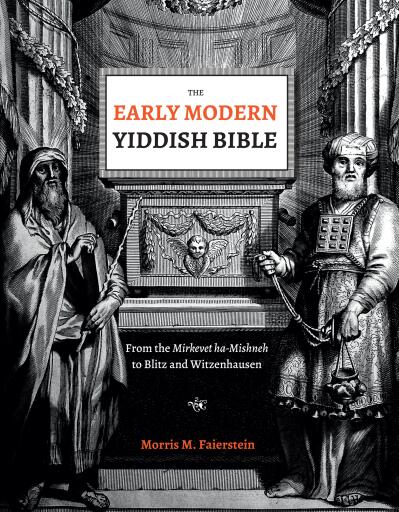
The Early Modern Yiddish Bible

The Early Modern Yiddish Bible

Par Faierstein, Morris M.

Publié par Hebrew Union College Press

English 417 pages 2023 ISBN 9780878207060
Temps de lecture estimé : 7 h 39 min
PDF

À propos de ce livre

The translation of the Bible into the vernacular is a venerable Jewish tradition, more than two thousand years old. Ashkenazi Jewish culture was a latecomer to the vernacular Bible, and it was only in the sixteenth century that the Yiddish Bible made its appearance in print. Almost one hundred years ago, Wilhelm Staerk and Albert Leitzmann's survey of Early Modern Yiddish Bible translations was the first attempt to define this genre of Early Modern Yiddish literature. In the intervening century there has been relatively little scholarly interest in these texts. The purpose of the present study is to survey the present state of research in this field and place these works in the context of the popular religious culture of Ashkenazi Jewry, which is defined by its use of Yiddish as a means of both oral communication and literary production. The subject of this study is every Yiddish work from the sixteenth and seventeenth centuries that is directly or indirectly related to the Bible. The survey begins with the Mirkevet ha-Mishneh, the first published Yiddish book, which is a biblical concordance, published in Cracow, 1534-36, and concludes with the two competing translations of the entire Bible into Yiddish by Yekutiel Blitz and Joseph Witzenhausen, published in Amsterdam, 1676-86. (These were translations without any accompanying commentaries, and were modeled on Protestant Bibles, like the English King James, or the German Luther Bible.) The study includes not only translations of biblical books, but also adaptations, reworkings, and paraphrases of biblical texts, appearing in diverse literary styles, by a wide variety of authors. King David, for example, is presented in the Shmuel Bukh as a combination of medieval chivalric hero and rabbinic scholar who is careful to observe the strictures of Halakhah. The story of Jonah is retold through a midrashic lens, and concludes with a kabbalistic parable that analogizes Jonah's journey to that of the soul from conception through life, death, and return to its heavenly source. Some authors take great liberties with the biblical text. The author of the paraphrase of Isaiah only includes what he considers to be prophetic utterances and disregards the rest of the book. Another author decides that the second half of the Torah is too legalistic and not worth retelling, so he ends his commentary after the giving of the Torah on Mount Sinai. As for the Five Scrolls, Lamentations is too depressing so he ignores it. There are also surprising inclusions in these volumes, such as the books of Judith and Susanna from the Apocrypha, and the very colorful medieval version of the Book of Ben Sira, which is considered by modern scholars to be a parody.

Disponibilité

The Early Modern Yiddish Bible est disponible en PDF dans 14 librairies en ligne. Parmi les librairies qui le proposent : Alpha Books, Bajalibros Argentina, Bajalibros Latam.

Langue
English
Partager

Questions fréquentes

Dans quels formats The Early Modern Yiddish Bible est-il disponible ?
The Early Modern Yiddish Bible est disponible en PDF dans 14 librairies en ligne.
Où puis-je acheter The Early Modern Yiddish Bible ?
Vous pouvez acheter The Early Modern Yiddish Bible sur Alpha Books, Bajalibros Argentina, Bajalibros Latam. Comparez toutes les options dans la liste de cette page.
Combien de temps faut-il pour lire The Early Modern Yiddish Bible ?
À un rythme de lecture moyen, The Early Modern Yiddish Bible se lit en environ 7 h 39 min (417 pages).

Notes et avis

Pas encore de note. Soyez le premier à donner votre avis sur ce livre.

Se connecter pour noter ce livre et donner votre avis.

Commentaires

Se connecter pour rejoindre la conversation.

Pas encore de commentaires.