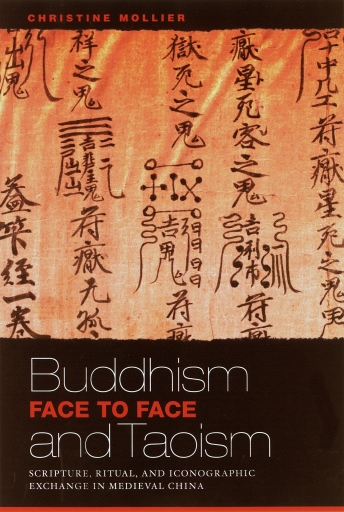
Buddhism and Taoism Face to Face
Pubblicato da University of Hawaii Press
English
2008
ISBN 9780824852139
eBook
Buy at Bajalibros Argentina
🇦🇷
 Association of University Presses - Tienda FILUNI
🇺🇸
Visita il negozio →
Association of University Presses - Tienda FILUNI
🇺🇸
Visita il negozio →
 Bajalibros Latam
🇺🇸
Visita il negozio →
Bajalibros Latam
🇺🇸
Visita il negozio →
 Bookshop Uruguay
🇺🇾
Visita il negozio →
Bookshop Uruguay
🇺🇾
Visita il negozio →
 Catademic
🇺🇸
Visita il negozio →
Catademic
🇺🇸
Visita il negozio →
Disponibile in 13 librerie
Association of University Presses - Tienda FILUNI
🇺🇸
Visita il negozio →
 Bajalibros Latam
🇺🇸
Visita il negozio →
Bookshop Uruguay
🇺🇾
Visita il negozio →
Catademic
🇺🇸
Visita il negozio →
Bajalibros Latam
🇺🇸
Visita il negozio →
Bookshop Uruguay
🇺🇾
Visita il negozio →
Catademic
🇺🇸
Visita il negozio →








Informazioni su questo libro
Christine Mollier reveals in this volume previously unexplored dimensions of the interaction between Buddhism and Taoism in medieval China. While scholars of Chinese religions have long recognized the mutual influences linking the two traditions, Mollier here brings to light their intense contest for hegemony in the domains of scripture and ritual. Drawing on a far-reaching investigation of canonical texts, together with manuscript sources from Dunhuang and the monastic libraries of Japan—many of them studied here for the first time—she demonstrates the competition and complementarity of the two great Chinese religions in their quest to address personal and collective fears of diverse ills, including sorcery, famine, and untimely death. In this context, Buddhist apocrypha and Taoist scriptures were composed through a process of mutual borrowing, yielding parallel texts, Mollier argues, that closely mirrored one another. Life-extending techniques, astrological observances, talismans, spells, and the use of effigies and icons to resolve the fundamental preoccupations of medieval society were similarly incorporated in both religions. In many cases, as a result, one and the same body of material can be found in both Buddhist and Taoist guises.
Among the exorcistic, prophylactic, and therapeutic ritual methods explored here in detail are the "Heavenly Kitchens" that grant divine nutrition to their adepts, incantations that were promoted to counteract bewitchment, as well as talismans for attaining longevity and the protection of stellar deities. The destiny of the Jiuku Tianzun, the Taoist bodhisattva whose salvific mission and iconography were modeled on Guanyin (Avalokitesvara), is examined at length. Through the case-studies set forth here, the patterns whereby medieval Buddhists and Taoists each appropriated and transformed for their own use the rites and scriptures oftheir rivals are revealed with unprecedented precision.
Buddhism and Taoism Face to Face is abundantly illustrated with drawings and diagrams from canonical and manuscript sources, together with art and artifacts photographed by the author in the course of her field research in China. Sophisticated in its analysis, broad in its synthesis of a variety of difficult material, and original in its interpretations, it will be required reading for those interested in East Asian religions and in the history of the medieval Chinese sciences, including astrology, medicine and divination.
Disponibilità
Buddhism and Taoism Face to Face è disponibile come eBook in 13 librerie online. Tra le librerie che lo vendono ci sono Association of University Presses - Tienda FILUNI, Bajalibros Argentina, Bajalibros Latam.
- Lingua
- English
Condividi
Domande frequenti
- In quali formati è disponibile Buddhism and Taoism Face to Face?
- Buddhism and Taoism Face to Face è disponibile come eBook in 13 librerie online.
- Dove posso comprare Buddhism and Taoism Face to Face?
- Puoi comprare Buddhism and Taoism Face to Face su Association of University Presses - Tienda FILUNI, Bajalibros Argentina, Bajalibros Latam. Confronta tutte le opzioni nell’elenco di questa pagina.
Valutazioni e recensioni
Ancora nessuna valutazione. Sii il primo a recensire questo libro.
Accedi per valutare e recensire questo libro.