Names on the Barracks Wall
Pubblicato da epubli
English
2026
eBook
Buy at Bajalibros Latam
🇺🇸
 Bajalibros Argentina
🇦🇷
Visita il negozio →
Bajalibros Argentina
🇦🇷
Visita il negozio →
 Bookshop Uruguay
🇺🇾
Visita il negozio →
Bookshop Uruguay
🇺🇾
Visita il negozio →
 Crisol Ebooks
🇵🇪
Visita il negozio →
Crisol Ebooks
🇵🇪
Visita il negozio →
 ebooks Libreria del GAM
🇨🇱
Visita il negozio →
ebooks Libreria del GAM
🇨🇱
Visita il negozio →
Disponibile in 7 librerie
Bajalibros Argentina
🇦🇷
Visita il negozio →
 Bookshop Uruguay
🇺🇾
Visita il negozio →
Crisol Ebooks
🇵🇪
Visita il negozio →
ebooks Libreria del GAM
🇨🇱
Visita il negozio →
Bookshop Uruguay
🇺🇾
Visita il negozio →
Crisol Ebooks
🇵🇪
Visita il negozio →
ebooks Libreria del GAM
🇨🇱
Visita il negozio →


Informazioni su questo libro
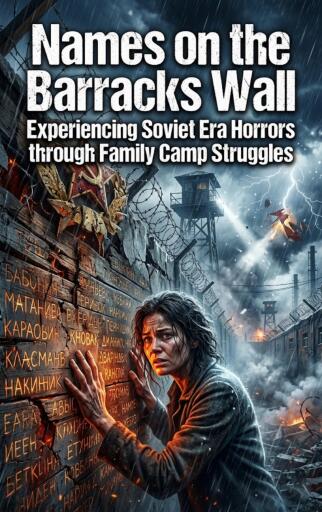
Stalin's terror did not only arrest individuals — it dismembered families. When the NKVD came for a father, the machinery of the Soviet state followed with calculated precision: wives were sentenced to five to eight years in forced labor camps, and children as young as eighteen months were seized and placed in state orphanages, ordered to be monitored for "anti-Soviet sentiments." In less than one year of the Great Terror alone, over 15,000 children were sent to orphanages when their parents disappeared into the Gulag. For these families, the horror was not a single event — it was a structured unraveling, engineered step by step by the state.
This book enters that unraveling through the intimate record of family experience — the letters sent from the transit trains, the mothers who hid their pregnancies in camp barracks, the children born behind wire who met their fathers only as strangers. It draws on the testimony of survivors like Anton Antonov-Ovseyenko, whose father was executed in the purges, whose mother died by suicide in prison, and who was himself arrested and sent to the Gulag as a young husband — only to return and find his wife had remarried. These are not exceptional cases. They are the grammar of an era, repeated in millions of variations across the Soviet Union from 1937 onward.
Children who survived the camp orphanages carried a particular silence into adulthood — labeled units, the children of "enemies of the people," they were taught to feel like criminals for the act of loving their parents. Those born inside the camps were taken from their mothers at age two and transferred to state institutions, entering a world in which teachers were forbidden to show them affection for fear of appearing sympathetic to the condemned. What the Gulag destroyed was not merely freedom — it was the language of family itself, the capacity to belong to someone without that belonging becoming a crime.
Disponibilità
Names on the Barracks Wall è disponibile come eBook in 7 librerie online. Tra le librerie che lo vendono ci sono Bajalibros Argentina, Bajalibros Latam, Bookshop Uruguay.
Categorie
- Lingua
- English
Condividi
Domande frequenti
- In quali formati è disponibile Names on the Barracks Wall?
- Names on the Barracks Wall è disponibile come eBook in 7 librerie online.
- Dove posso comprare Names on the Barracks Wall?
- Puoi comprare Names on the Barracks Wall su Bajalibros Argentina, Bajalibros Latam, Bookshop Uruguay. Confronta tutte le opzioni nell’elenco di questa pagina.
Valutazioni e recensioni
Ancora nessuna valutazione. Sii il primo a recensire questo libro.
Accedi per valutare e recensire questo libro.