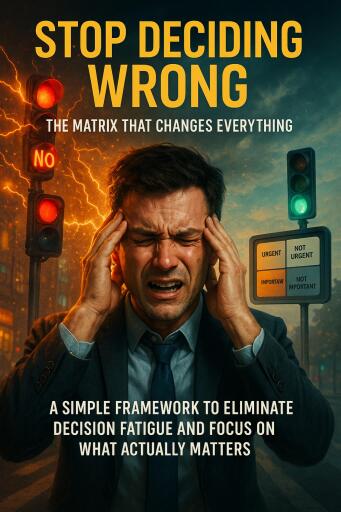
Stop Deciding Wrong: The Matrix That Changes Everything
Pubblicato da epubli
English
2025
ISBN 9783565126309
eBook
Buy at Bajalibros Argentina
🇦🇷
 Bajalibros Latam
🇺🇸
Visita il negozio →
Bajalibros Latam
🇺🇸
Visita il negozio →
 Bookshop Uruguay
🇺🇾
Visita il negozio →
Bookshop Uruguay
🇺🇾
Visita il negozio →
 Crisol Ebooks
🇵🇪
Visita il negozio →
Crisol Ebooks
🇵🇪
Visita il negozio →
 ebooks Libreria del GAM
🇨🇱
Visita il negozio →
ebooks Libreria del GAM
🇨🇱
Visita il negozio →
Disponibile in 9 librerie
 Bajalibros Latam
🇺🇸
Visita il negozio →
Bookshop Uruguay
🇺🇾
Visita il negozio →
Crisol Ebooks
🇵🇪
Visita il negozio →
ebooks Libreria del GAM
🇨🇱
Visita il negozio →
Bajalibros Latam
🇺🇸
Visita il negozio →
Bookshop Uruguay
🇺🇾
Visita il negozio →
Crisol Ebooks
🇵🇪
Visita il negozio →
ebooks Libreria del GAM
🇨🇱
Visita il negozio →




Informazioni su questo libro
You make thousands of decisions daily. Most waste your mental energy on low-impact choices while critical decisions pile up. Decision fatigue sets in by noon, and your productivity collapses by afternoon. You're not lacking discipline—you're using the wrong decision-making system.
Stop Deciding Wrong introduces a proven framework that transforms how you evaluate tasks, opportunities, and commitments. Rather than relying on gut feeling or urgency, this system provides a visual, strategic method to categorize every decision into four quadrants: what's urgent and important, what's important but not urgent, what's urgent but unimportant, and what's neither. This simple shift eliminates decision paralysis and forces clarity on where your time actually belongs.
Inside you'll learn how to build your personal Priority Matrix, apply it to real-world scenarios from emails to major projects, and use it to automate recurring decisions. You'll discover how to say no strategically, protect your peak hours for high-impact work, and stop drowning in false urgencies. The framework works across all domains—entrepreneurship, management, personal projects, even family decisions. Once you see your priorities mapped visually, the fog lifts.
This isn't theoretical. It's immediately actionable. Within one day of applying this system, you'll reclaim hours of wasted decision-making and redirect that mental energy toward what moves the needle. Your productivity doesn't need more tools. It needs better decisions. This matrix makes better decisions automatic.
Disponibilità
Stop Deciding Wrong: The Matrix That Changes Everything è disponibile come eBook in 9 librerie online. Tra le librerie che lo vendono ci sono Bajalibros Argentina, Bajalibros Latam, Bookshop Uruguay.
Categorie
- Lingua
- English
Condividi
Domande frequenti
- In quali formati è disponibile Stop Deciding Wrong: The Matrix That Changes Everything?
- Stop Deciding Wrong: The Matrix That Changes Everything è disponibile come eBook in 9 librerie online.
- Dove posso comprare Stop Deciding Wrong: The Matrix That Changes Everything?
- Puoi comprare Stop Deciding Wrong: The Matrix That Changes Everything su Bajalibros Argentina, Bajalibros Latam, Bookshop Uruguay. Confronta tutte le opzioni nell’elenco di questa pagina.
Valutazioni e recensioni
Ancora nessuna valutazione. Sii il primo a recensire questo libro.
Accedi per valutare e recensire questo libro.