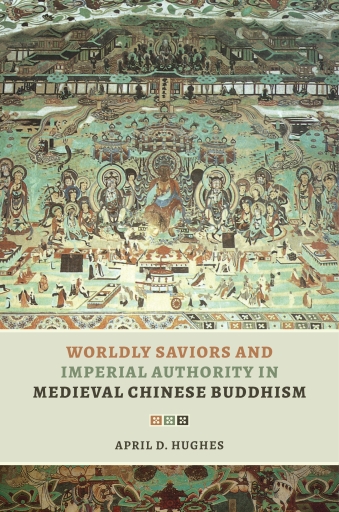
Worldly Saviors and Imperial Authority in Medieval Chinese Buddhism
Pubblicato da University of Hawaii Press
English
2021
ISBN 9780824888756
eBook
Buy at Ebooks Librería Antártica
🇨🇱
 Association of University Presses - Tienda FILUNI
🇺🇸
Visita il negozio →
Association of University Presses - Tienda FILUNI
🇺🇸
Visita il negozio →
 Bajalibros Argentina
🇦🇷
Visita il negozio →
Bajalibros Argentina
🇦🇷
Visita il negozio →
 Bajalibros Latam
🇺🇸
Visita il negozio →
Bajalibros Latam
🇺🇸
Visita il negozio →
 Bookshop Uruguay
🇺🇾
Visita il negozio →
Bookshop Uruguay
🇺🇾
Visita il negozio →
 Catademic
🇺🇸
Visita il negozio →
Catademic
🇺🇸
Visita il negozio →
Disponibile in 13 librerie
Association of University Presses - Tienda FILUNI
🇺🇸
Visita il negozio →
Bajalibros Argentina
🇦🇷
Visita il negozio →
Bajalibros Latam
🇺🇸
Visita il negozio →
Bookshop Uruguay
🇺🇾
Visita il negozio →
Catademic
🇺🇸
Visita il negozio →








Informazioni su questo libro
Although scholars have long assumed that early Chinese political authority was rooted in Confucianism, rulership in the medieval period was not bound by a single dominant tradition. To acquire power, emperors deployed objects and figures derived from a range of traditions imbued with religious and political significance. Author April D. Hughes demonstrates how dynastic founders like Wu Zhao (Wu Zetian, r. 690–705), the only woman to rule China under her own name, and Yang Jian (Emperor Wen, r. 581–604), the first ruler of the Sui dynasty, closely identified with Buddhist worldly saviors and Wheel-Turning Kings to legitimate their rule. During periods of upheaval caused by the decline of the Dharma, worldly saviors arrived on earth to quell chaos and to rule and liberate their subjects simultaneously. By incorporating these figures into the imperial system, sovereigns were able to depict themselves both as monarchs and as buddhas or bodhisattvas in uncertain times.
In this inventive and original work, Hughes traces worldly saviors—in particular Maitreya Buddha and Prince Moonlight—as they appeared in apocalyptic scriptures from Dunhuang, claims to the throne made by various rebel leaders, and textual interpretations and assertions by Yang Jian and Wu Zhao. Yang Jian associated himself with Prince Moonlight and took on the persona of a Wheel-Turning King whose offerings to the Buddha were not flowers and incense but weapons of war to reunite a long-fragmented empire and revitalize the Dharma. Wu Zhao was associated with several different worldly savior figures. In addition, she saw herself as the incarnation of a Wheel-Turning King for whom it was said the Seven Treasures manifested as material representations of his right to rule. Wu Zhao duly had the Seven Treasures created and put on display whenever she held audiences at court.
The worldly savior figure allowed rulers to inhabit the highest role in the religious realm along with the supreme role in the political sphere. This incorporation transformed notions of Chinese imperial sovereignty, and associating rulers with a buddha or bodhisattva continued long after the close of the medieval period.
Disponibilità
Worldly Saviors and Imperial Authority in Medieval Chinese Buddhism è disponibile come eBook in 13 librerie online. Tra le librerie che lo vendono ci sono Association of University Presses - Tienda FILUNI, Bajalibros Argentina, Bajalibros Latam.
Categorie
- Lingua
- English
Condividi
Domande frequenti
- In quali formati è disponibile Worldly Saviors and Imperial Authority in Medieval Chinese Buddhism?
- Worldly Saviors and Imperial Authority in Medieval Chinese Buddhism è disponibile come eBook in 13 librerie online.
- Dove posso comprare Worldly Saviors and Imperial Authority in Medieval Chinese Buddhism?
- Puoi comprare Worldly Saviors and Imperial Authority in Medieval Chinese Buddhism su Association of University Presses - Tienda FILUNI, Bajalibros Argentina, Bajalibros Latam. Confronta tutte le opzioni nell’elenco di questa pagina.
Valutazioni e recensioni
Ancora nessuna valutazione. Sii il primo a recensire questo libro.
Accedi per valutare e recensire questo libro.