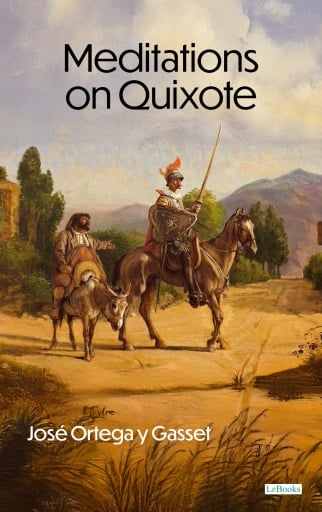
Meditations on Quixote
Autor: Gasset, José Ortega y
Wydane przez Lebooks Editora
English
2025
ISBN 9786558947370
eBook
Buy at Bajalibros Latam
🇺🇸
Bajalibros Latam
🇺🇸
Odwiedź sklep →
Martins Fontes Paulista
🇧🇷
Odwiedź sklep →
Disal - Distribuidora de Conhecimento
🇧🇷
Odwiedź sklep →

Ebooks Librería Antártica
🇨🇱
Odwiedź sklep →
Bajalibros Argentina
🇦🇷
Odwiedź sklep →
Sanborns Ebooks
🇲🇽
Odwiedź sklep →
ebooks Libreria del GAM
🇨🇱
Odwiedź sklep →
Bookshop Uruguay
🇺🇾
Odwiedź sklep →
Ebooks Yenny - El Ateneo
🇦🇷
Odwiedź sklep →
Crisol Ebooks
🇵🇪
Odwiedź sklep →
Dostępne w 10 księgarniach
Martins Fontes Paulista
🇧🇷
Odwiedź sklep →
Disal - Distribuidora de Conhecimento
🇧🇷
Odwiedź sklep →

Ebooks Librería Antártica
🇨🇱
Odwiedź sklep →
Sanborns Ebooks
🇲🇽
Odwiedź sklep →
ebooks Libreria del GAM
🇨🇱
Odwiedź sklep →
Ebooks Yenny - El Ateneo
🇦🇷
Odwiedź sklep →
Crisol Ebooks
🇵🇪
Odwiedź sklep →
O tej książce
Meditations on Quixote, published in 1914, is the first major philosophical work by José Ortega y Gasset, and it marks the beginning of his distinctive intellectual path. Conceived as both a literary and philosophical essay, the book uses Cervantes's Don Quixote as a framework to explore fundamental questions about reality, art, and the human condition. Ortega does not offer a mere interpretation of the novel; rather, he turns it into a meditation on how individuals construct meaning within their circumstances and how culture emerges from the tension between imagination and reality.
The work opens with Ortega's famous declaration that "I am I and my circumstance, and if I do not save it, I do not save myself." This phrase encapsulates his philosophy of vital reason, which asserts that human life cannot be understood apart from the concrete world in which it unfolds. Through Don Quixote, Ortega examines the relationship between idealism and reality: Don Quixote's adventures symbolize the human tendency to impose dreams and ideals upon a resistant world. Yet, rather than dismissing this idealism as folly, Ortega interprets it as a necessary expression of life's creative energy — the will to transcend one's condition while still being bound to it.
In his meditations, Ortega also reflects on Spain's cultural identity, seeing in Don Quixote a mirror of the Spanish spirit: passionate, idealistic, and deeply introspective. He laments that Spain has often been unable to reconcile its poetic imagination with the demands of reason and progress. Thus, Meditations on Quixote becomes both a philosophical treatise and a cultural diagnosis — a call for Spain, and by extension humanity, to rediscover a balance between life, reason, and imagination.
José Ortega y Gasset was a Spanish philosopher and essayist, widely regarded as one of the most influential intellectual figures of 20th-century Spain. His work is characterized by a profound reflection on culture, reason, and human life, proposing a vitalist philosophy that sought to renew European thought from a distinctly Hispanic perspective.
Kategorie
- Język
- English
Udostępnij
Może ci się też spodobać
Ensino de filosofia
Kohan, Walter
Breve tratado sobre Deus, o ser humano e sua felicidade - Ed. Bolso
Espinosa, Baruch de
Sobre o sofrimento do mundo e outros ensaios
Schopenhauer, Arthur
Divagações sobre um mundo em crise
Oliveira, Régis Fernandes de
Ensayo sobre la justicia
Rosatti, Horacio
Uma interpretação da história universal
Gasset, José Ortega y