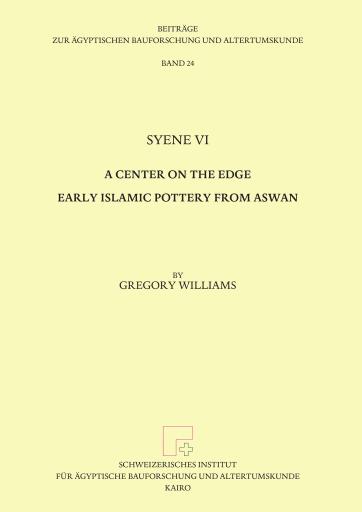
Syene VI
Autor: Williams, Gregory
Wydane przez PeWe-Verlag
English
201 stron
2022
ISBN 9783689850111
Szacowany czas czytania: 3 godz. 41 min
PDF
Buy at Ebooks Yenny - El Ateneo
🇦🇷
 Alpha Books
🇨🇴
Odwiedź sklep →
Alpha Books
🇨🇴
Odwiedź sklep →
 Bajalibros Argentina
🇦🇷
Odwiedź sklep →
Bajalibros Argentina
🇦🇷
Odwiedź sklep →
 Bajalibros Latam
🇺🇸
Odwiedź sklep →
Bajalibros Latam
🇺🇸
Odwiedź sklep →
 Bookshop Uruguay
🇺🇾
Odwiedź sklep →
Bookshop Uruguay
🇺🇾
Odwiedź sklep →
 Crisol Ebooks
🇵🇪
Odwiedź sklep →
Crisol Ebooks
🇵🇪
Odwiedź sklep →
Dostępne w 13 księgarniach
Alpha Books
🇨🇴
Odwiedź sklep →
Bajalibros Argentina
🇦🇷
Odwiedź sklep →
Bajalibros Latam
🇺🇸
Odwiedź sklep →
Bookshop Uruguay
🇺🇾
Odwiedź sklep →
Crisol Ebooks
🇵🇪
Odwiedź sklep →








O tej książce
In the 9th century CE, the city of Aswan, Egypt was a prosperous provincial capital on the pilgrimage route to Mecca and Medina via the Red Sea, as well as trade routes connecting the Nile River to the Wadi al-Allaqi mines, Egypt's main source of gold. The city was identified by medieval writers and geographers as situated at the frontier between Muslim Egypt and Christian Nubia. Salvage excavations under the auspices of the Swiss-Egyptian mission in Syene/Old Aswan have revealed considerable evidence of medieval Islamic activity. Evidence from 9th - 10th century ceramic assemblages uncovered during these investigations is compared and contrasted with a variety of historical sources concerning this same period. The evidence suggests that a particular style of common, utilitarian ceramics produced in the Aswan region was utilized frequently and carried or exported extensively throughout Upper Egypt, the Eastern Desert, and Lower Nubia during the 9th-10th centuries and beyond. The assemblages demonstrate a considerable distinction with the corpus of common ceramics of Fustat and Lower Egypt in the early Islamic period, as well as those of contemporary Upper Nubia and sites further south along the Nile into Northeastern Africa. Aswan and the First Cataract region came to function as a central node of a network marked by a regional material culture that transcended traditional political or religious divisions between Egypt and Nubia or Muslim and Christian. The evidence from Aswan provides an alternative interpretation of medieval landscapes and regionalism, one which prioritizes the material culture of daily life over the presumed divisions of political history or religious boundaries.
Dostępność
Syene VI jest dostępna jako PDF w 13 księgarni internetowej. Wśród księgarni, które ją oferują, są Alpha Books, Bajalibros Argentina, Bajalibros Latam.
Kategorie
- Język
- English
Udostępnij
Najczęstsze pytania
- W jakich formatach dostępna jest Syene VI?
- Syene VI jest dostępna jako PDF w 13 księgarni internetowej.
- Gdzie mogę kupić Syene VI?
- Możesz kupić Syene VI w Alpha Books, Bajalibros Argentina, Bajalibros Latam. Porównaj wszystkie opcje na liście na tej stronie.
- Ile czasu zajmuje przeczytanie Syene VI?
- Przy przeciętnym tempie czytania Syene VI zajmuje około 3 godz. 41 min (201 stron).
Oceny i recenzje
Brak ocen. Bądź pierwszą osobą, która zrecenzuje tę książkę.
Zaloguj się aby ocenić i zrecenzować tę książkę.