Zum Hauptinhalt springen
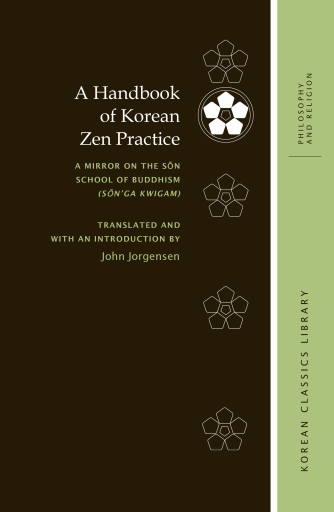
A Handbook of Korean Zen Practice

A Handbook of Korean Zen Practice

Von Jorgensen, John, Taesa, Sosan

Herausgegeben von University of Hawaii Press

English 2015 ISBN 9780824854201
eBook

Über dieses Buch

Sŏn (Japanese Zen) has been the dominant form of Buddhism in Korea from medieval times to the present. A Handbook of Korean Zen Practice: A Mirror on the Sŏn School of Buddhism (Sŏn'ga kwigam) was the most popular guide for Sŏn practice and life ever published in Korea and helped restore Buddhism to popularity after its lowest point in Korean history. It was compiled before 1569 by Sŏsan Hyujŏng (1520–1604), later famed as the leader of a monk army that helped defend Korea against a massive Japanese invasion in 1592. In addition to succinct quotations from sutras, the text also contained quotations from selected Chinese and Korean works together with Hyujŏng's explanations. Because of its brevity and organization, the work proved popular and was reprinted many times in Korea and Japan before 1909. A Handbook of Korean Zen Practice commences with the ineffability of the enlightened state, and after a tour through doctrine and practice it returns to its starting point. The doctrinal rationale for practice that leads to enlightenment is based on the Mahayana Awakening of Faith, but the practice Hyujŏng enjoins readers to undertake is very different: a method of meditation derived from the kongan (Japanese koan) called hwadu (Chinese huatou), or "point of the story," the story being the kongan. This method was developed by Dahui Zonggao (1089–1163) and was imported into Korea by Chinul (1158–1210). The most famous hwadu is the mu (no) answer by Zhaozhou to the question, "Does a dog have a buddha-nature?" Hyujŏng warns of pitfalls in this practice, such as the delusion that one is already enlightened. A proper understanding of doctrine is required before practicing hwadu. Practice also requires faith and an experienced teacher. Hyujŏng outlines the specifics of practice, such as rules of conduct and chanting and mindfulness of the Buddha, and stresses the requirements for living the life of a monk. At the end of the text he returns to the hwadu, the need for a teacher, and hence the importance of lineage. He sketches out the distinctive methods of practice of the chief Sŏn (Chinese Chan) lineages. His final warning is not to be attached to the text. The version of the text translated here is the earliest and the longest extant. It was "translated" into Korean from Chinese by one of Hyujŏng's students to aid Korean readers. The present volume contains a brief history of hwadu practice and theory, a life of Hyujŏng, and a summary of the text, plus a detailed, annotated translation. It should be of interest to practitioners of meditation and students of East Asian Buddhism and Korean history.

Verfügbarkeit

A Handbook of Korean Zen Practice ist als eBook in 13 Online-Buchhandlungen erhältlich. Zu den Buchhandlungen, die es führen, gehören Association of University Presses - Tienda FILUNI, Bajalibros Argentina, Bajalibros Latam.

Sprache
English
Teilen

Häufige Fragen

In welchen Formaten ist A Handbook of Korean Zen Practice erhältlich?
A Handbook of Korean Zen Practice ist als eBook in 13 Online-Buchhandlungen erhältlich.
Wo kann ich A Handbook of Korean Zen Practice kaufen?
Du kannst A Handbook of Korean Zen Practice bei Association of University Presses - Tienda FILUNI, Bajalibros Argentina, Bajalibros Latam kaufen. Vergleiche alle Optionen in der Liste auf dieser Seite.

Bewertungen und Rezensionen

Noch keine Bewertungen. Sei der Erste, der dieses Buch rezensiert.

Anmelden um dieses Buch zu bewerten und zu rezensieren.

Kommentare

Anmelden um an der Unterhaltung teilzunehmen.

Noch keine Kommentare.