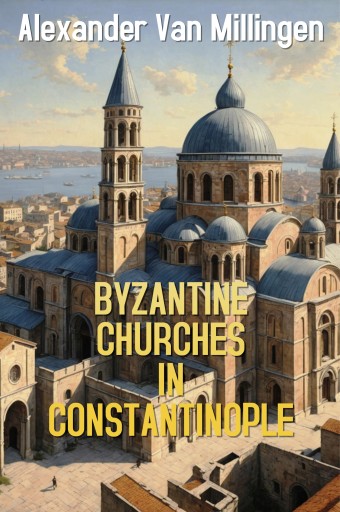
Byzantine Churches in Constantinople
Herausgegeben von E-Kitap Projesi & Cheapest Books
English
2024
ISBN 9786256629035
eBook
Buy at Crisol Ebooks
🇵🇪
 Alpha Books
🇨🇴
Shop besuchen →
Alpha Books
🇨🇴
Shop besuchen →
 Bajalibros Argentina
🇦🇷
Shop besuchen →
Bajalibros Argentina
🇦🇷
Shop besuchen →
 Bajalibros Latam
🇺🇸
Shop besuchen →
Bajalibros Latam
🇺🇸
Shop besuchen →
 Bookshop Uruguay
🇺🇾
Shop besuchen →
Bookshop Uruguay
🇺🇾
Shop besuchen →
Verfügbar in 15 Buchhandlungen
Alpha Books
🇨🇴
Shop besuchen →
Bajalibros Argentina
🇦🇷
Shop besuchen →
Bajalibros Latam
🇺🇸
Shop besuchen →
Bookshop Uruguay
🇺🇾
Shop besuchen →











Über dieses Buch
This volume is a sequel to the work I published, several years ago, under the title, Byzantine Constantinople: the Walls of the City, and adjoining Historical Sites. In that work the city was viewed, mainly, as the citadel of the Roman Empire in the East, and the bulwark of civilization for more than a thousand years. But the city of Constantine was not only a mighty fortress. It was, moreover, the centre of a great religious community, which elaborated dogmas, fostered forms of piety, and controlled an ecclesiastical administration that have left a profound impression upon the thought and life of mankind. New Rome was a Holy City. It was crowded with churches, hallowed, it was believed, by the remains of the apostles, prophets, saints, and martyrs of the Catholic Church; shrines at which men gathered to worship, from near and far, as before the gates of heaven. These sanctuaries were, furthermore, constructed and beautified after a fashion which marks a distinct and important period in the history of art, and have much to interest the artist and the architect. We have, consequently, reasons enough to justify our study of the churches of Byzantine Constantinople.Of the immense number of the churches which once filled the city but a small remnant survives. Earthquakes, fires, pillage, neglect, not to speak of the facility with which a Byzantine structure could be shorn of its glory, have swept the vast majority off the face of the earth, leaving not a rack behind. In most cases even the sites on which they stood cannot be identified. The places which knew them know them no more. Scarcely a score of the old churches of the city are left to us, all with one exception converted into mosques and sadly altered. The visitor must, therefore, be prepared for disappointment. Age is not always a crown of glory; nor does change of ownership and adaptation to different ideas and tastes necessarily conduce to improvement. We are not looking at flowers in their native clime or in full bloom, but at flowers in a herbarium so to speak, or left to wither and decay. As we look upon them we have need of imagination to see in faded colours the graceful forms and brilliant hues which charmed and delighted the eyes of men in other days.In the preparation of this work I have availed myself of the aid afforded by previous students in the same field of research, and I have gratefully acknowledged my debt to them whenever there has been occasion to do so. At the same time this is a fresh study of the subject, and has been made with the hope of confirming what is true, correcting mistakes, and gathering additional information. Attention has been given to both the history and the architecture of these buildings. The materials for the former are, unfortunately, all too scanty. No continuous records of any of these churches exist. A few incidents scattered over wide tracts of time constitute all that can be known. Still, disconnected incidents though they be, they give us glimpses of the characteristic thoughts and feelings of a large mass of our humanity during a long period of history.The student of the architecture of these churches likewise labours under serious disadvantages. Turkish colour-wash frequently conceals what is necessary for a complete survey; while access to the higher parts of a building by means of scaffolding or ladders is often impossible under present circumstances. Hence the architect cannot always speak positively, and must leave many an interesting point in suspense.Care has been taken to distinguish the original parts of a building from alterations made in Byzantine days or since the Turkish conquest; while, by the prominence given to the variety of type which the churches present, the life and movement observable in Byzantine ecclesiastical art has been made clear, and the common idea that it was a stereotyped art has been proved to be without foundation.
Verfügbarkeit
Byzantine Churches in Constantinople ist als eBook in 15 Online-Buchhandlungen erhältlich. Zu den Buchhandlungen, die es führen, gehören Alpha Books, Bajalibros Argentina, Bajalibros Latam.
Kategorien
- Sprache
- English
Teilen
Häufige Fragen
- In welchen Formaten ist Byzantine Churches in Constantinople erhältlich?
- Byzantine Churches in Constantinople ist als eBook in 15 Online-Buchhandlungen erhältlich.
- Wo kann ich Byzantine Churches in Constantinople kaufen?
- Du kannst Byzantine Churches in Constantinople bei Alpha Books, Bajalibros Argentina, Bajalibros Latam kaufen. Vergleiche alle Optionen in der Liste auf dieser Seite.
Bewertungen und Rezensionen
Noch keine Bewertungen. Sei der Erste, der dieses Buch rezensiert.
Anmelden um dieses Buch zu bewerten und zu rezensieren.