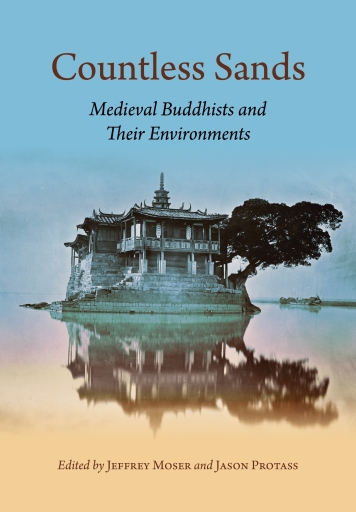
Countless Sands
Herausgegeben von University of Hawaii Press
English
2024
ISBN 9780824898182
eBook
Buy at Ebooks Yenny - El Ateneo
🇦🇷
 Association of University Presses - Tienda FILUNI
🇺🇸
Shop besuchen →
Association of University Presses - Tienda FILUNI
🇺🇸
Shop besuchen →
 Bajalibros Argentina
🇦🇷
Shop besuchen →
Bajalibros Argentina
🇦🇷
Shop besuchen →
 Bajalibros Latam
🇺🇸
Shop besuchen →
Bajalibros Latam
🇺🇸
Shop besuchen →
 Bookshop Uruguay
🇺🇾
Shop besuchen →
Bookshop Uruguay
🇺🇾
Shop besuchen →
 Catademic
🇺🇸
Shop besuchen →
Catademic
🇺🇸
Shop besuchen →
Verfügbar in 13 Buchhandlungen
Association of University Presses - Tienda FILUNI
🇺🇸
Shop besuchen →
Bajalibros Argentina
🇦🇷
Shop besuchen →
Bajalibros Latam
🇺🇸
Shop besuchen →
Bookshop Uruguay
🇺🇾
Shop besuchen →
Catademic
🇺🇸
Shop besuchen →








Über dieses Buch
Countless Sands presents engaging analyses of the diverse relationships between Buddhism and the environment that existed in medieval Asia. Recent years have witnessed a surge in publications across the humanities that advance powerful ethical and political arguments to account for the human failure to respond effectively to global climate change. While the contributors to this volume are attuned to this challenge, rather than present explicit political arguments, they pursue a subtler effort to historicize the environment as a site and subject of Buddhist practice while providing research grounded in rigorous analysis of complex and fragmentary sources. The volume thereby mitigates against the Orientalist, East-West binaries that have long informed the invocation of Buddhism in Euro-American environmental discourses. As the chapters collectively demonstrate, there was no singular, consistently “Buddhist” understanding of the natural world, but innumerable, varied engagements preserved in discrete texts, images, and artifacts.
Through specific case studies, the authors consider such questions as: How did premodern Buddhists understand what we today call “the environment”? How did they think about their earth? How, when, and where did the various processes of the earth actually impinge on the practices of historical Buddhists? What kinds of “environmental imaginations” informed specific Buddhist practices? In so doing, the authors explore the connections between the ways in which historical Buddhist communities interacted with their environments and how they understood those environments. In the broader field of Buddhist studies, Countless Sands contributes to ongoing efforts to expand the locus of inquiry from textually based investigations of Buddhist doctrine to a broader examination of the complex and varied place of Buddhism in the lives of historical communities. The book furthers this broader process by casting it in environmental terms and will engage readers looking for models of thought-provoking historical analysis on environmental themes.
Verfügbarkeit
Countless Sands ist als eBook in 13 Online-Buchhandlungen erhältlich. Zu den Buchhandlungen, die es führen, gehören Association of University Presses - Tienda FILUNI, Bajalibros Argentina, Bajalibros Latam.
Kategorien
- Sprache
- English
Teilen
Häufige Fragen
- In welchen Formaten ist Countless Sands erhältlich?
- Countless Sands ist als eBook in 13 Online-Buchhandlungen erhältlich.
- Wo kann ich Countless Sands kaufen?
- Du kannst Countless Sands bei Association of University Presses - Tienda FILUNI, Bajalibros Argentina, Bajalibros Latam kaufen. Vergleiche alle Optionen in der Liste auf dieser Seite.
Bewertungen und Rezensionen
Noch keine Bewertungen. Sei der Erste, der dieses Buch rezensiert.
Anmelden um dieses Buch zu bewerten und zu rezensieren.