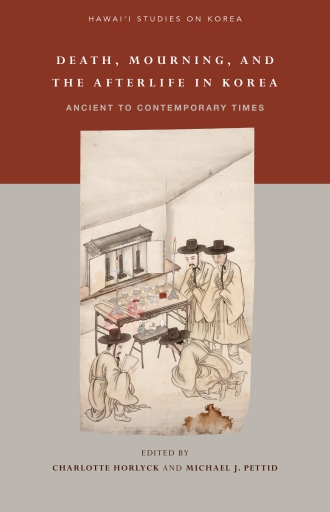
Death, Mourning, and the Afterlife in Korea
Herausgegeben von University of Hawaii Press
English
2014
ISBN 9780824850876
eBook
Buy at ebookskitapenas
🇬🇹
 Association of University Presses - Tienda FILUNI
🇺🇸
Shop besuchen →
Association of University Presses - Tienda FILUNI
🇺🇸
Shop besuchen →
 Bajalibros Argentina
🇦🇷
Shop besuchen →
Bajalibros Argentina
🇦🇷
Shop besuchen →
 Bajalibros Latam
🇺🇸
Shop besuchen →
Bajalibros Latam
🇺🇸
Shop besuchen →
 Bookshop Uruguay
🇺🇾
Shop besuchen →
Bookshop Uruguay
🇺🇾
Shop besuchen →
 Catademic
🇺🇸
Shop besuchen →
Catademic
🇺🇸
Shop besuchen →
Verfügbar in 13 Buchhandlungen
Association of University Presses - Tienda FILUNI
🇺🇸
Shop besuchen →
Bajalibros Argentina
🇦🇷
Shop besuchen →
Bajalibros Latam
🇺🇸
Shop besuchen →
Bookshop Uruguay
🇺🇾
Shop besuchen →
Catademic
🇺🇸
Shop besuchen →








Über dieses Buch
Death and the activities and beliefs surrounding it can teach us much about the ideals and cultures of the living. While biologically death is an end to physical life, this break is not quite so apparent in its mental and spiritual aspects. Indeed, the influence of the dead over the living is sometimes much greater than before death. This volume takes a multidisciplinary approach in an effort to provide a fuller understanding of both historic and contemporary practices linked with death in Korea.
Contributors from Korea and the West incorporate the approaches of archaeology, history, literature, religion, and anthropology in addressing a number of topics organized around issues of the body, disposal of remains, ancestor worship and rites, and the afterlife. The first two chapters explore the ways in which bodies of the dying and the dead were dealt with from the Greater Silla Kingdom (668–935) to the mid-twentieth century. Grave construction and goods, cemeteries, and memorial monuments in the Koryŏ (918–1392) and the twentieth century are then discussed, followed by a consideration of ancestral rites and worship, which have formed an inseparable part of Korean mortuary customs since premodern times. Chapters address the need to appease the dead both in shamanic and Confucians contexts. The final section of the book examines the treatment of the dead and how the state of death has been perceived. Ghost stories provide important insight into how death was interpreted by common people in the Koryŏ and Chosŏn (1392–1910) while nonconformist narratives of death such as the seventeenth-century romantic novel Kuunmong point to a clear conflict between Buddhist thought and practice and official Neo-Confucian doctrine. Keeping with unendorsed views on death, the final chapter explores how death and the afterlife were understood by early Korean Catholics of the eighteenth and nineteenth centuries.
Death, Mourning, and the Afterlife in Korea fills a significant gap in studies on Korean society and culture as well as on East Asian mortuary practices. By approaching its topic from a variety of disciplines and extending its historical reach to cover both premodern and modern Korea, it is an important resource for scholars and students in a variety of fields.
Verfügbarkeit
Death, Mourning, and the Afterlife in Korea ist als eBook in 13 Online-Buchhandlungen erhältlich. Zu den Buchhandlungen, die es führen, gehören Association of University Presses - Tienda FILUNI, Bajalibros Argentina, Bajalibros Latam.
Kategorien
- Sprache
- English
Teilen
Häufige Fragen
- In welchen Formaten ist Death, Mourning, and the Afterlife in Korea erhältlich?
- Death, Mourning, and the Afterlife in Korea ist als eBook in 13 Online-Buchhandlungen erhältlich.
- Wo kann ich Death, Mourning, and the Afterlife in Korea kaufen?
- Du kannst Death, Mourning, and the Afterlife in Korea bei Association of University Presses - Tienda FILUNI, Bajalibros Argentina, Bajalibros Latam kaufen. Vergleiche alle Optionen in der Liste auf dieser Seite.
Bewertungen und Rezensionen
Noch keine Bewertungen. Sei der Erste, der dieses Buch rezensiert.
Anmelden um dieses Buch zu bewerten und zu rezensieren.