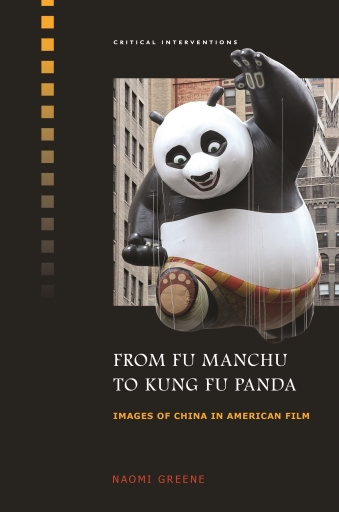
From Fu Manchu to Kung Fu Panda
Von Greene, Naomi
Herausgegeben von University of Hawaii Press
English
2014
ISBN 9780824850104
eBook
Buy at Catademic
🇺🇸
Catademic
🇺🇸
Shop besuchen →
Bajalibros Latam
🇺🇸
Shop besuchen →
Verfügbar in 9 Buchhandlungen
Catademic
🇺🇸
Shop besuchen →
Über dieses Buch
<p>Throughout the twentieth century, American filmmakers have embraced cinematic representations of China. Beginning with D.W. Griffith’s silent classic <i>Broken Blossoms</i> (1919) and ending with the computer-animated <i>Kung Fu Panda</i> (2008), this book explores China’s changing role in the American imagination. Taking viewers into zones that frequently resist logical expression or more orthodox historical investigation, the films suggest the welter of intense and conflicting impulses that have surrounded China. They make clear that China has often served as the very embodiment of “otherness”—a kind of yardstick or cloudy mirror of America itself. It is a mirror that reflects not only how Americans see the racial “other” but also a larger landscape of racial, sexual, and political perceptions that touch on the ways in which the nation envisions itself and its role in the world. <br><br>In the United States, the exceptional emotional charge that imbues images of China has tended to swing violently from positive to negative and back again: China has been loved and—as is generally the case today—feared. Using film to trace these dramatic fluctuations, author Naomi Greene relates them to the larger arc of historical and political change. Suggesting that filmic images both reflect and fuel broader social and cultural impulses, she argues that they reveal a constant tension or dialectic between the “self” and the “other.” Significantly, with the important exception of films made by Chinese or Chinese American directors, the Chinese other is almost invariably portrayed in terms of the American self. Placed in a broader context, this ethnocentrism is related both to an ever-present sense of American exceptionalism and to a Manichean world view that perceives other countries as friends or enemies. <br><br>Greene analyzes a series of influential films, including classics like <i>Shanghai Express</i> (1932), <i> The Bitter Tea of General Yen </i> (1933), <i>The Good Earth </i> (1936), and <i>Shanghai Gesture </i> (1941); important cold war films such as <i>The Manchurian Candidate </i> (1962) and <i>The Sand Pebbles </i> (1966); and a range of contemporary films, including <i>Chan is Missing</i> (1982), <i>The Wedding Banquet </i> (1993), <i>Kundun</i> (1997), <i>Mulan</i> (1998), and <i>Shanghai Noon</i> (2000). Her consideration makes clear that while many stereotypes and racist images of the past have been largely banished from the screen, the political, cultural, and social impulses they embodied are still alive and well.</p>
Kategorien
- Sprache
- English
Teilen
Das könnte dir auch gefallen
Educating Monks
Borchert, Thomas A.
Edward Hopper
Souter, Gerry
Pictographs and Petroglyphs of the Oregon Country
Loring, J. Malcolm, Loring, Louise
Temática - Artes - Legado Pré-História
Planeta do Brasil, Editora
El cielo al revés
Eduardo Escallón Largacha
Temática - Artes - Islã
Planeta do Brasil, Editora