Zum Hauptinhalt springen
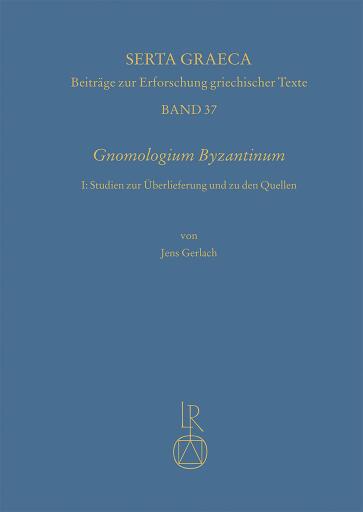
Gnomologium Byzantinum

Gnomologium Byzantinum

Von Gerlach, Jens

Herausgegeben von Dr Ludwig Reichert Verlag

English 1,602 Seiten 2025
Geschätzte Lesezeit: 29 Std. 22 Min.
PDF

Über dieses Buch

The early Byzantine corpus of sayings named Gnomologium Byzantinum has survived in around forty Greek manuscripts from the 10th to 18th centuries with widely divergent compilative forms. This polymorphism reflects the intentions of teachers, who selected, rearranged, adapted and reformulated the sayings according to their interests and target groups. The analysis of the genesis of the corpus, from the first compilation (redaction A) through numerous intermediate stages to the more recent, well-preserved redactions (A2 and B2), reveals its significance as a document of educational history, as it served as a medium for teaching ethics, language and rhetoric in Byzantium for around a millennium. This is the first time that the corpus of sayings, which is divided into an alphabetically and a thematically organised half, has been examined in its original redactional form and analysed from a philological, manuscriptological, source-analytical and educational-historical perspective. The edition of redactions A2 and B2 replaces the older partial editions by Curt Wachsmuth (1882) and Heinrich Schenkl (1889), which provide the thematic (the so-called "demokrito-epiktetische Sammlung") and the alphabetical (the so-called "Florilegium Ἄριστον καὶ πρῶτον μάθημα") half of the corpus isolated and in a fictional, nowhere transmitted compilative form, as the early division into the branches A and B was not taken into account. The separate edition now allows to retrace the transmission paths of the approximately 400 sentences and apophthegms with unprecedented precision, according to the different redactional stages. Thanks to an innovative method that combines compilative structural analysis with textual criticism, the whole polymorphic history both of compilative forms and of the text from the first compilation down to the most recent textual witnesses can be presented stemmatically. The complicated indirect tradition of individual Gnom.Byz.-sayings in dependent collections can also be analysed in this way: In addition to the descendancy running via the Corpus Parisinum and its descendants (Maximus etc.), there is a hitherto unknown line of tradition that draws on a further, non-transmitted 'universal gnomologium' as an intermediary source. In addition to special observations on "tradition" (Ü) and "language" (S), the commentary also addresses the reader interested in intellectual history without knowledge of Greek with the section "content" (I) and the translation by explaining the content and context of each saying and establishing references to ancient philosophical traditions. Crucial are the four main sources, for which the origin from or, respectively, the mediation via a milieu described as "Pythagorean" can be made probable. The genuinely neo-Pythagorean sources in particular provide important insights into ancient spirituality and mentality.

Verfügbarkeit

Gnomologium Byzantinum ist als PDF in 7 Online-Buchhandlungen erhältlich. Zu den Buchhandlungen, die es führen, gehören Bajalibros Argentina, Bajalibros Latam, Bookshop Uruguay.

Sprache
English
Teilen

Häufige Fragen

In welchen Formaten ist Gnomologium Byzantinum erhältlich?
Gnomologium Byzantinum ist als PDF in 7 Online-Buchhandlungen erhältlich.
Wo kann ich Gnomologium Byzantinum kaufen?
Du kannst Gnomologium Byzantinum bei Bajalibros Argentina, Bajalibros Latam, Bookshop Uruguay kaufen. Vergleiche alle Optionen in der Liste auf dieser Seite.
Wie lange dauert es, Gnomologium Byzantinum zu lesen?
Bei durchschnittlichem Lesetempo dauert Gnomologium Byzantinum etwa 29 Std. 22 Min. (1602 Seiten).

Bewertungen und Rezensionen

Noch keine Bewertungen. Sei der Erste, der dieses Buch rezensiert.

Anmelden um dieses Buch zu bewerten und zu rezensieren.

Kommentare

Anmelden um an der Unterhaltung teilzunehmen.

Noch keine Kommentare.