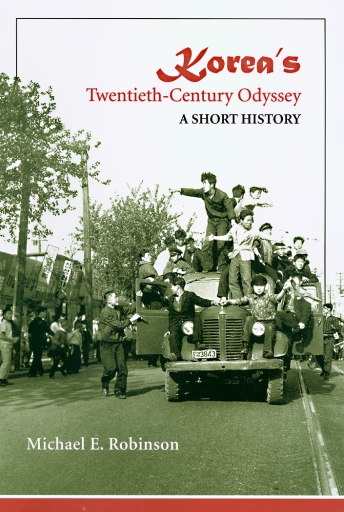
Korea's Twentieth-Century Odyssey
Herausgegeben von University of Hawaii Press
English
233 Seiten
2007
ISBN 9780824863272
Geschätzte Lesezeit: 4 Std. 16 Min.
PDF
Buy at Ebooks Agustin
🇪🇸
 Association of University Presses - Tienda FILUNI
🇺🇸
Shop besuchen →
Association of University Presses - Tienda FILUNI
🇺🇸
Shop besuchen →
 Bajalibros Argentina
🇦🇷
Shop besuchen →
Bajalibros Argentina
🇦🇷
Shop besuchen →
 Bajalibros Latam
🇺🇸
Shop besuchen →
Bajalibros Latam
🇺🇸
Shop besuchen →
 Bookshop Uruguay
🇺🇾
Shop besuchen →
Bookshop Uruguay
🇺🇾
Shop besuchen →
 Catademic
🇺🇸
Shop besuchen →
Catademic
🇺🇸
Shop besuchen →
Verfügbar in 13 Buchhandlungen
Association of University Presses - Tienda FILUNI
🇺🇸
Shop besuchen →
Bajalibros Argentina
🇦🇷
Shop besuchen →
Bajalibros Latam
🇺🇸
Shop besuchen →
Bookshop Uruguay
🇺🇾
Shop besuchen →
Catademic
🇺🇸
Shop besuchen →








Über dieses Buch
For more than half of the twentieth century, the Korean peninsula has been divided between two hostile and competitive nation-states, each claiming to be the sole legitimate expression of the Korean nation. The division remains an unsolved problem dating to the beginnings of the Cold War and now projects the politics of that period into the twenty-first century. Korea’s Twentieth-Century Odyssey is designed to provide readers with the historical essentials upon which to unravel the complex politics and contemporary crises that currently exist in the East Asian region. Beginning with a description of late-nineteenth-century imperialism, Michael Robinson shows how traditional Korean political culture shaped the response of Koreans to multiple threats to their sovereignty after being opened to the world economy by Japan in the 1870s. He locates the origins of both modern nationalism and the economic and cultural modernization of Korea in the twenty years preceding the fall of the traditional state to Japanese colonialism in 1910.
Robinson breaks new ground with his analysis of the colonial period, tracing the ideological division of contemporary Korea to the struggle of different actors to mobilize a national independence movement at the time. More importantly, he locates the reason for successful Japanese hegemony in policies that included—and thus implicated—Koreans within the colonial system. He concludes with a discussion of the political and economic evolution of South and North Korea after 1948 that accounts for the valid legitimacy claims of both nation-states on the peninsula.
Verfügbarkeit
Korea's Twentieth-Century Odyssey ist als PDF in 13 Online-Buchhandlungen erhältlich. Zu den Buchhandlungen, die es führen, gehören Association of University Presses - Tienda FILUNI, Bajalibros Argentina, Bajalibros Latam.
Kategorien
- Sprache
- English
Teilen
Häufige Fragen
- In welchen Formaten ist Korea's Twentieth-Century Odyssey erhältlich?
- Korea's Twentieth-Century Odyssey ist als PDF in 13 Online-Buchhandlungen erhältlich.
- Wo kann ich Korea's Twentieth-Century Odyssey kaufen?
- Du kannst Korea's Twentieth-Century Odyssey bei Association of University Presses - Tienda FILUNI, Bajalibros Argentina, Bajalibros Latam kaufen. Vergleiche alle Optionen in der Liste auf dieser Seite.
- Wie lange dauert es, Korea's Twentieth-Century Odyssey zu lesen?
- Bei durchschnittlichem Lesetempo dauert Korea's Twentieth-Century Odyssey etwa 4 Std. 16 Min. (233 Seiten).
Bewertungen und Rezensionen
Noch keine Bewertungen. Sei der Erste, der dieses Buch rezensiert.
Anmelden um dieses Buch zu bewerten und zu rezensieren.