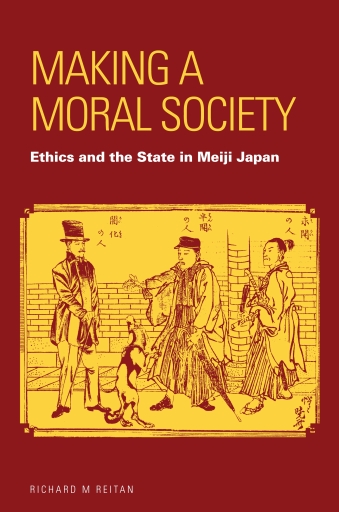
Making a Moral Society
Herausgegeben von University of Hawaii Press
English
250 Seiten
2009
ISBN 9780824837686
Geschätzte Lesezeit: 4 Std. 35 Min.
PDF
Buy at Bajalibros Argentina
🇦🇷
 Association of University Presses - Tienda FILUNI
🇺🇸
Shop besuchen →
Association of University Presses - Tienda FILUNI
🇺🇸
Shop besuchen →
 Bajalibros Latam
🇺🇸
Shop besuchen →
Bajalibros Latam
🇺🇸
Shop besuchen →
 Bookshop Uruguay
🇺🇾
Shop besuchen →
Bookshop Uruguay
🇺🇾
Shop besuchen →
 Catademic
🇺🇸
Shop besuchen →
Catademic
🇺🇸
Shop besuchen →
Verfügbar in 13 Buchhandlungen
Association of University Presses - Tienda FILUNI
🇺🇸
Shop besuchen →
 Bajalibros Latam
🇺🇸
Shop besuchen →
Bookshop Uruguay
🇺🇾
Shop besuchen →
Catademic
🇺🇸
Shop besuchen →
Bajalibros Latam
🇺🇸
Shop besuchen →
Bookshop Uruguay
🇺🇾
Shop besuchen →
Catademic
🇺🇸
Shop besuchen →








Über dieses Buch
This innovative study of ethics in Meiji Japan (1868–1912) explores the intense struggle to define a common morality for the emerging nation-state. In the Social Darwinist atmosphere of the time, the Japanese state sought to quell uprisings and overcome social disruptions so as to produce national unity and defend its sovereignty against Western encroachment. Morality became a crucial means to attain these aims. Moral prescriptions for re-ordering the population came from all segments of society, including Buddhist, Christian, and Confucian apologists; literary figures and artists; advocates of natural rights; anarchists; and women defending nontraditional gender roles. Each envisioned a unity grounded in its own moral perspective. It was in this tumultuous atmosphere that the academic discipline of ethics (rinrigaku) emerged—not as a value-neutral, objective form of inquiry as its practitioners claimed, but a state-sponsored program with its own agenda.
After examining the broad moral space of "civilization," Richard Reitan turns to the dominant moral theories of early Meiji and the underlying epistemology that shaped and authorized them. He considers the fluidity of moral subjectivity (the constantly shifting nature of norms to which we are subject and how we apprehend, resist, or practice them) by juxtaposing rinrigaku texts with moral writings by religious apologists. By the beginning of the 1890s, moral philosophers in Japan were moving away from the empiricism and utilitarianism of the prior decade and beginning to place "spirit" at the center of ethical inquiry. This shift is explored through the works of two thinkers, Inoue Tetsujiro (1856–1944) and Nakashima Rikizo (1858–1918), the first chair of ethics at Tokyo Imperial University. Finally, Reitan takes a detailed look at the national morality movement (kokumin dotoku) and its close association with the state before concluding with an outline of some conceptual linkages between the Meiji and later periods.
With its highly original thesis, clear and sound methodology, and fluid prose, Making a Moral Society will be welcomed by scholars and students of both Japanese intellectual history and ethics in general.
Verfügbarkeit
Making a Moral Society ist als PDF in 13 Online-Buchhandlungen erhältlich. Zu den Buchhandlungen, die es führen, gehören Association of University Presses - Tienda FILUNI, Bajalibros Argentina, Bajalibros Latam.
Kategorien
- Sprache
- English
Teilen
Häufige Fragen
- In welchen Formaten ist Making a Moral Society erhältlich?
- Making a Moral Society ist als PDF in 13 Online-Buchhandlungen erhältlich.
- Wo kann ich Making a Moral Society kaufen?
- Du kannst Making a Moral Society bei Association of University Presses - Tienda FILUNI, Bajalibros Argentina, Bajalibros Latam kaufen. Vergleiche alle Optionen in der Liste auf dieser Seite.
- Wie lange dauert es, Making a Moral Society zu lesen?
- Bei durchschnittlichem Lesetempo dauert Making a Moral Society etwa 4 Std. 35 Min. (250 Seiten).
Bewertungen und Rezensionen
Noch keine Bewertungen. Sei der Erste, der dieses Buch rezensiert.
Anmelden um dieses Buch zu bewerten und zu rezensieren.