Zum Hauptinhalt springen
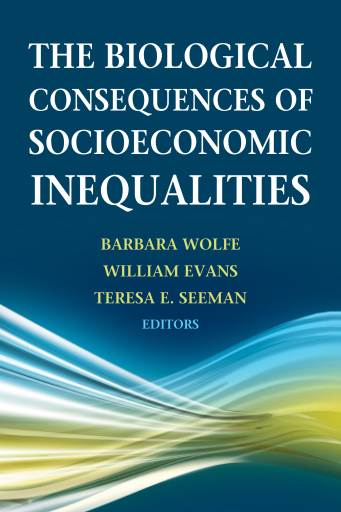
The Biological Consequences of Socioeconomic Inequalities

The Biological Consequences of Socioeconomic Inequalities

Herausgegeben von Russell Sage Foundation

English 2012 ISBN 9781610447935
eBook

Über dieses Buch

Social scientists have repeatedly uncovered a disturbing feature of economic inequality: people with larger incomes and better education tend to lead longer, healthier lives. This pattern holds across all ages and for virtually all measures of health, apparently indicating a biological dimension of inequality. But scholars have only begun to understand the complex mechanisms that drive this disparity. How exactly do financial well-being and human physiology interact? The Biological Consequences of Socioeconomic Inequalities incorporates insights from the social and biological sciences to quantify the biology of disadvantage and to assess how poverty gets under the skin to impact health. Drawing from unusually rich datasets of biomarkers, brain scans, and socioeconomic measures, Biological Consequences of Socioeconomic Inequalities illustrates exciting new paths to understanding social inequalities in health. Barbara Wolfe, William N. Evans and Nancy Adler begin the volume with a critical evaluation of the literature on income and health, providing a lucid review of the difficulties of establishing clear causal pathways between the two variables. In their chapter, Arun S. Karlamangla, Tara L. Gruenewald, and Teresa E. Seeman outline the potential of biomarkers—such as cholesterol, heart pressure, and C-reactive protein—to assess and indicate the factors underlying health. Edith Chen, Hannah M. C. Schreier, and Meanne Chan reveal the empirical power of biomarkers by examining asthma, a condition steeply correlated with socioeconomic status. Their analysis shows how stress at the individual, family, and neighborhood levels can increase the incidence of asthma. The volume then turns to cognitive neuroscience, using biomarkers in a new way to examine the impact of poverty on brain development. Jamie Hanson, Nicole Hair, Amitabh Chandra, Ed Moss, Jay Bhattacharya, Seth D. Pollack, and Barbara Wolfe use a longitudinal Magnetic Resonance Imaging (MRI) study of children between the ages of four and eighteen to study the link between poverty and limited cognition among children. Michelle C. Carlson, Christopher L. Seplaki, and Teresa E. Seeman also focus on brain development to examine the role of socioeconomic status in cognitive decline among older adults. Featuring insights from the biological and social sciences, Biological Consequences of Socioeconomic Inequalities will be an essential resource for scholars interested in socioeconomic disparities and the biological imprint that material deprivation leaves on the human body.

Verfügbarkeit

The Biological Consequences of Socioeconomic Inequalities ist als eBook in 13 Online-Buchhandlungen erhältlich. Zu den Buchhandlungen, die es führen, gehören Association of University Presses - Tienda FILUNI, Bajalibros Argentina, Bajalibros Latam.

Sprache
English
Teilen

Häufige Fragen

In welchen Formaten ist The Biological Consequences of Socioeconomic Inequalities erhältlich?
The Biological Consequences of Socioeconomic Inequalities ist als eBook in 13 Online-Buchhandlungen erhältlich.
Wo kann ich The Biological Consequences of Socioeconomic Inequalities kaufen?
Du kannst The Biological Consequences of Socioeconomic Inequalities bei Association of University Presses - Tienda FILUNI, Bajalibros Argentina, Bajalibros Latam kaufen. Vergleiche alle Optionen in der Liste auf dieser Seite.

Bewertungen und Rezensionen

Noch keine Bewertungen. Sei der Erste, der dieses Buch rezensiert.

Anmelden um dieses Buch zu bewerten und zu rezensieren.

Kommentare

Anmelden um an der Unterhaltung teilzunehmen.

Noch keine Kommentare.