Zum Hauptinhalt springen
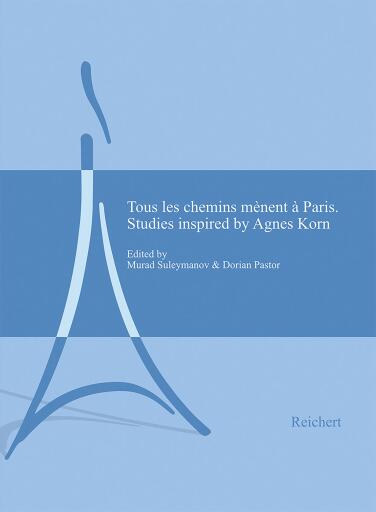
Tous les chemins mènent à Paris

Tous les chemins mènent à Paris

Herausgegeben von Dr Ludwig Reichert Verlag

English 180 Seiten 2022
Geschätzte Lesezeit: 3 Std. 18 Min.
PDF

Über dieses Buch

This volume honouring Dr Agnes Korn's continuing support for young researchers is a collection of nine papers contributed by authors whose careers and lives have been touched by Dr Korn's academic guidance and personal mentoring during her time in Paris as a chargée de recherches at CNRS. The topics covered in the chapters highlight Dr Korn's wide array of research interests, encompassing cultures and languages – both classical and modern, written and oral, well-known and underdescribed – of the Caucasus–Iran–Central Asia area and its immediate vicinity. The book consists of a preface and an introduction, as well as chapters presenting novel research, influenced directly or indirectly by Dr Korn's deep academic involvement. The chapters, each reviewed by one referee under a double-blind peer review process, deal with issues of etymology, historical language contact, morphology and syntax, typological modelling, and folk practices. Bernard (pp. 15–24) explores the etymology of Māzandarān, the name of a province situated in Northern Iran. Chamot-Rooke (pp. 25–36) analyses the use and origin of smām, a previously unacknowledged Tocharian A lexical item. Gérardin (pp. 37–71) introduces a new typological approach to classifying and describing the valency of Georgian verbs. Jügel (pp. 73–91) suggests that linguistic areas with a dominant religious affiliation may be considered a factor influencing the historical dialectology of Persian. Kontovas (pp. 93–106) presents an overview of the reflexes of Proto-Iranian *w- in modern and classical Iranian languages with the intention of determining if language contact has affected their distribution. Mascagni (pp. 107–121) provides a comprehensive description of a traditional Baloch string instrument, the sorūd, and reflects on the process of repairing and tuning this instrument, which he has documented. Pastor (pp. 123–150) examines processes of degrammaticalization of the pronominal clitic =(e)š in colloquial Persian leading to the derivation of new lexical items. Rochant (pp. 151–163) proposes a new way of looking at the nominal inflection paradigm of Andi after analysing the behaviour of a formative encountered in specific lexical classes. Finally, Suleymanov (pp. 165–178) illustrates a phenomenon of syncretism in a Tat variety which codes possessor and source in an identical manner and delves into the question of its origin. The current volume may be of interest to linguists specializing in Iranian and other Indo-European, as well as East Caucasian (Nakh-Dagestanian) and South Caucasian (Kartvelian) languages. The chapter documenting musical practices of the Baloch minority of Oman may equally appeal to ethnomusicologists.

Verfügbarkeit

Tous les chemins mènent à Paris ist als PDF in 7 Online-Buchhandlungen erhältlich. Zu den Buchhandlungen, die es führen, gehören Bajalibros Argentina, Bajalibros Latam, Bookshop Uruguay.

Sprache
English
Teilen

Häufige Fragen

In welchen Formaten ist Tous les chemins mènent à Paris erhältlich?
Tous les chemins mènent à Paris ist als PDF in 7 Online-Buchhandlungen erhältlich.
Wo kann ich Tous les chemins mènent à Paris kaufen?
Du kannst Tous les chemins mènent à Paris bei Bajalibros Argentina, Bajalibros Latam, Bookshop Uruguay kaufen. Vergleiche alle Optionen in der Liste auf dieser Seite.
Wie lange dauert es, Tous les chemins mènent à Paris zu lesen?
Bei durchschnittlichem Lesetempo dauert Tous les chemins mènent à Paris etwa 3 Std. 18 Min. (180 Seiten).

Bewertungen und Rezensionen

Noch keine Bewertungen. Sei der Erste, der dieses Buch rezensiert.

Anmelden um dieses Buch zu bewerten und zu rezensieren.

Kommentare

Anmelden um an der Unterhaltung teilzunehmen.

Noch keine Kommentare.